In the context of the continuously expanding F&B sector and HoReCa channels, optimizing operational costs for enterprises has increasingly become a top priority task. For restaurant chains, hotels, central kitchens to ready-to-eat food processing manufacturers,… utilizing products that are safe, stable in quality, and convenient for transport and preservation is exceptionally critical.
Answering that demand, products applying Retort technology are regarded as a comprehensive solution helping enterprises extend food shelf life, drop reliance on cold chain logistics, and lift efficiency inside mass production as well as broad distribution. Let us explore deeply the diverse applications of this technology in modern food production packaging.
- Current Challenges in the F&B and HoReCa Supply Chain
- Why Retort Technology is the Definitive Solution for F&B and HoReCa Enterprises
- Diverse Applications of Retort in the F&B and HoReCa Sectors
- Critical Parameters Food Enterprises Must Evaluate Before Adopting Retort Systems
- Nature Foods (NFC) - Your Premier Accredited Retort Manufacturer in Vietnam
- Conclusion
- Frequently Asked Questions About Retort Technology in F&B and HoReCa (FAQ)
Current Challenges in the F&B and HoReCa Supply Chain
The F&B industry and HoReCa channel are continuously demonstrating aggressive growth alongside the expansion of restaurant chains, luxury hotels, central kitchen operations, corporate catering services, and processed convenience food sectors. Moving parallel with that rapid growth is an increasingly strict baseline tracking final lot quality, stable volume guarantees, and streamlined floor efficiency. Modern consumers no longer settle merely for appealing flavor profiles, but actively dictate that products be safe, convenient, and unvarying in lot uniformity at all times.
This environment places heavy pressure on food enterprises looking to construct an efficient supply chain, spanning automated manufacturing, warehouse preservation, long-distance transport, to retail distribution channels. Identifying robust engineering solutions that can extend raw material shelf life while maintaining uncompromising sensory properties has become a core priority for many operators within the food domain.
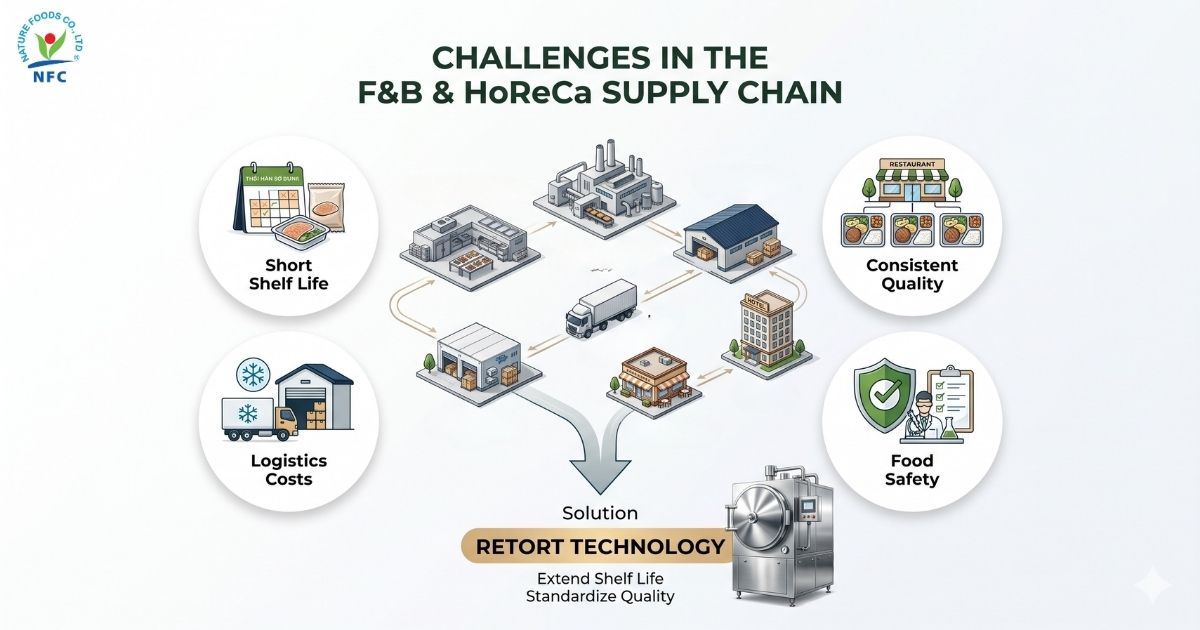
Narrow Shelf Life Windows Place Heavy Strain on Production and Logistics
For many fresh agricultural crop materials or processed foods, a narrow shelf life window continuously presents a massive bottleneck inside supply logistics. Enterprises face the administrative friction of running small production batches, preserving high delivery frequencies, and tightly auditing warehouse inventory parameters to dampen material waste margins.
As commercial distribution scales up, this operational math grows increasingly complex. Moving product blocks to disparate storefronts, distant provinces, or executing formal export shipping requires long logistics timelines, while material quality parameters must remain bulletproof. Devoid of an adapted processing solution, companies face severe product degradation risks, high mechanical loss margins, and expanding variable overhead costs across the downstream supply pipeline.
Securing Uniform Quality Over Complex Multi-Site Operations
For corporate restaurant groups, luxury resort hospitality brands, or franchise networks, delivering an identical sensory experience to end diners is the deciding benchmark governing master brand equity. However, when individual retail branches independently execute raw material sorting, prep, and primary kitchen workflows, final batch quality can fluctuate due to variable worker skills, localized operational deviations, or inconsistent storage parameters at separate locations.
This missing batch uniformity not only impacts final consumer brand recall but drives up training budgets, quality assurance (QA/QC) friction, and floor oversight overhead. Because of this, leading food enterprises are actively pursuing solutions that can standardize ingredients and core recipes right at a single central kitchen or processing plant, enabling retail endpoints to simply heat or plate the product before service.
Rising Logistics Costs and Strict Warehouse Preservation Overheads
Logistics has consistently stood as one of the heaviest budget items for F&B and HoReCa companies, particularly tracking processed lines that mandate refrigerated or deep-frozen storage parameters. Maintaining continuous cold rooms, heavy reefer transport fleets, and strict temperature logging protocols swells operating expenses dramatically, especially when brands scale out cross-country distribution footprints.
Beyond core cost parameters, cold chain structures introduce high operational risk into transit paths. Any single breakdown in localized temperature thresholds immediately triggers enzymic browning or microbial degradation, driving up lot losses and compromising brand integrity.
In an environment where global logistics rates remain volatile, exploring advanced processing methodologies that can completely decouple inventory from strict cold storage dependencies has emerged as a dominant B2B trend.
Complying With Strict Food Safety Regulatory Standards
Next to floor operating efficiencies, enterprises must satisfy strict bio-safety compliance codes enforced by automated retail chains, distribution networks, and cross-border export custom clearances. Analytical metrics governing microbial counts, lot-to-batch stability, full product lineage traceability, and post-preservation shelf parameters directly dictate a manufacturer’s market competitiveness.
Particularly for raw materials servicing automated restaurant kitchens, hotel banquets, institutional food services, or global export shipments, preserving invariant batch criteria over extended timelines is a mandatory baseline. This pushes corporate buyers to analyze past basic ingredient sorting toward investing in advanced food processing and packaging preservation technology.
The Strategic Transition Toward Supply Chain Optimization via Modern Preservation
To cleanly solve these logistical friction points, forward-thinking F&B and HoReCa entities are heavily adopting advanced preservation technologies designed to expand useful shelf limits, trim factory operating expenses, and amplify distribution agility. Product development divisions today look past isolated preservation toward holistic solutions that simultaneously capture multi-layered milestones: protecting fresh sensory attributes, ensuring absolute food safety, eliminating raw material waste, and raising supply chain agility.
Within this scope, industrial Retort processing is increasingly recognized as the ultimate fit. Beyond supporting lengthy shelf parameters under ambient warehouse conditions, this technology streamlines recipe standardization on a massive scale, facilitating large automated runs. This underlying efficiency is why Retort continues to gain massive traction inside the master product development blueprints of modern commercial food manufacturers.
Why Retort Technology is the Definitive Solution for F&B and HoReCa Enterprises
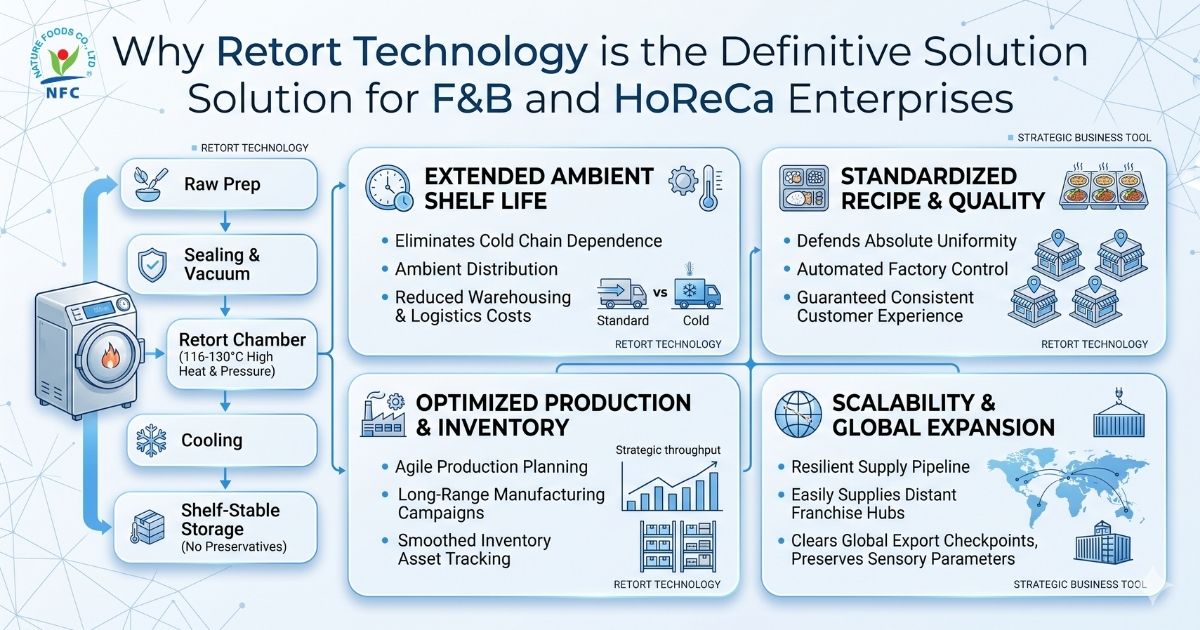
The fundamental principle behind Retort technology relies on execution of in-package thermal sterilization, running on a standardized automated pipeline:
Raw Material Preparation => Precise Recipe Dosing => Hermetic Sealing => Mechanical Vacuum Evacuation (upon request) => Retort Sterilization Chamber (Heated within a high-pressure 116–130°C envelope to achieve commercial sterility benchmarks) => Rapid Phase Cooling => Shelf-stable inventory stored at room temperature over extended lifespans with zero added chemical preservatives.
Leveraging these functional advantages, Retort processed food inputs flawlessly fulfill the most urgent operational needs of the commercial F&B and HoReCa networks:
Extending Shelf Life Boundaries Without Cold Chain Logistics Upkeep
As introduced, Retort operates as a technology that sterilizes the product blocks after they have been hermetically sealed inside high-barrier packages. Consequently, all target vegetative cells and heat-resistant bacterial spores are systematically eradicated inside the pressurized thermal chamber. Once the lots exit cooling phases, they can be easily distributed under simple ambient conditions, locking in an extended shelf life devoid of expensive cold-chain networks.
Insulating operations from continuous cold storage dependencies translates directly to optimized warehousing budgets, lighter container shipping costs, and a smaller factory footprint, lifting variable profit margins across your complete supply network.
Standardizing Recipe Properties on a High-Volume Industrial Scale
When complex recipe bases or semi-processed components are assembled under automated factory parameters, sealed within high-barrier Retort pouches, and shipped to multi-site retail outlets, defending absolute lot-to-batch uniformity becomes exceptionally simple. Procurement offices can slash high-end chef salaries and compress human training timelines, as branch endpoints no longer manage detailed raw prep or crop-to-crop taste fluctuations.
This system entirely eliminates reliance on the variable kitchen skills of local floor workers, guaranteeing that your final customers experience identical sensory presentation and flavor profiles, regardless of which geographic franchise store they walk into.
Optimizing Plant Production Throughput and Inventory Asset Management
Expanding useful shelf boundaries introduces immense strategic agility into master production and distribution charts. Rather than running a constant cycle of small, emergency batches to answer immediate retail orders, companies can map out long-range automated manufacturing campaigns, maximizing factory throughput capacity and smoothing out warehouse asset tracking.
For corporate distributors operating broad multi-channel networks or supplying complex downstream buyers, this functional advantage sharpens market responsiveness while driving down inventory handling overheads.
Providing a Predictable Foundation for Scale and Global Expansion
For growing F&B and HoReCa operations, scaling past regional footprints relies not just on core recipe excellence, but fundamentally concerns constructing a resilient, highly agile supply pipeline.
Adopting an advanced packaging preservation architecture allows companies to easily roll out central kitchen templates, supply distant franchise hubs, optimize corporate catering pipelines, or clear strict global export border checkpoints while protecting the sensory parameters of the brand across months of transit.
Because of these structural values, industrial Retort processing functions not merely as a basic food preservation method, but as an strategic business tool engineered to streamline multi-site floor operations, elevate cross-border margins, and capture market shares in the modern food marketplace.
Diverse Applications of Retort in the F&B and HoReCa Sectors
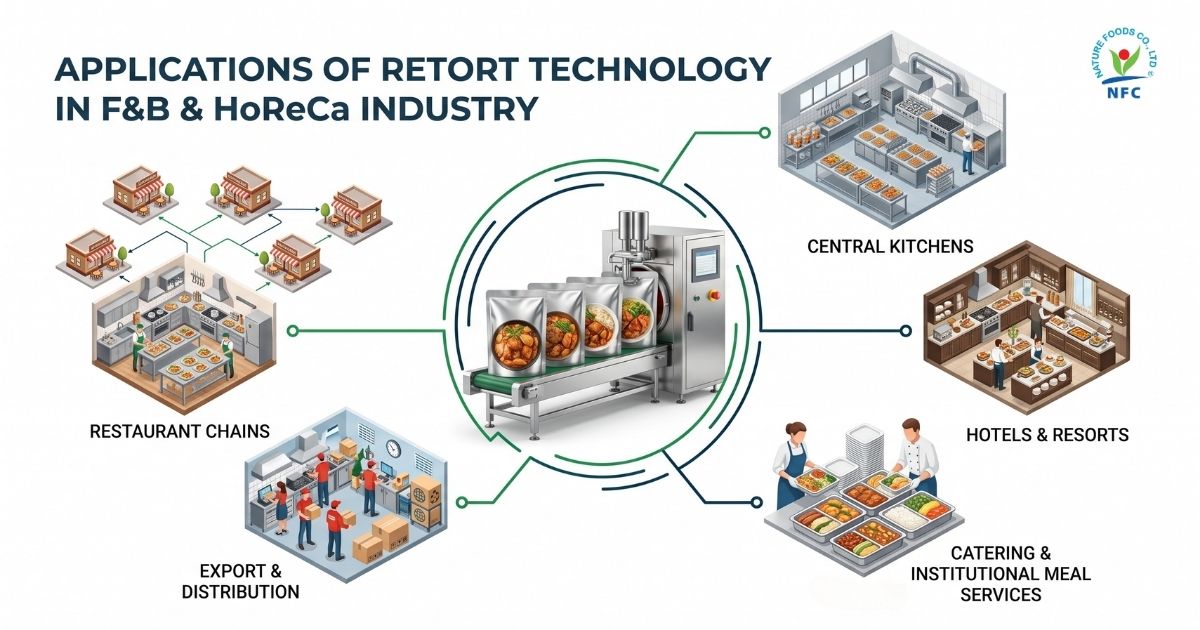
Every commercial configuration operating within the F&B and HoReCa landscape maps out private operational criteria regarding food assembly, shelf tracking, and lot distribution. While corporate restaurant chains mandate strict lot-to-batch uniformity between distinct storefronts, large hotels and industrial catering vendors place higher priority on rapid bulk serving capacity during high-volume events. Recognizing these needs, Retort technology functions past baseline preservation to act as an strategic operational manager driving higher floor efficiency and optimized enterprise margins.
Restaurant Chains and Multi-Site Franchise Models
For high-volume restaurant chains or commercial franchise labels, maintaining unvarying dish uniformity across all venues directly governs brand equity and consumer trust. When store counts scale up aggressively, relying on manual localized cooking workflows at individual branches introduces flavor drift, variable presentation, and delayed table serving times.
Implementing Retort processing enables corporate brands to completely standardize intricate recipe components or ready entrees at a centralized automated facility. Disparate branch endpoints simply execute short finishing công đoạn—such as hâm nóng, plating, or matching with basic fresh toppings—prior to immediate guest service.
This integrated flow dramatically compresses order fulfillment times, cuts down complex localized staff training, minimizes culinary preparation mistakes, and preserves absolute batch identity across the whole national network.
Central Kitchens – Standardizing Mass Production Workflows
Central kitchen frameworks have emerged as a dominant operational model for modern F&B enterprises due to their capacity to concentrate production blocks and enforce precise quality criteria at a single plant floor.
When combined with high-capacity Retort lines, companies can manufacture large advance lots of signature noodle broths, multi-layered savory sauces, slow-simmered stews, or pre-cooked meal components. These batches are subsequently moved down broad distribution networks while preserving immaculate lot metrics across logistics and warehousing lifespans.
This synchronized architecture maximizes plant output economics, slashes physical footprint requirements at target storefronts, and gives business development offices total agility when deploying new store rollouts.
Large Hotels and Luxury Hospitality Resorts
Within hotel and luxury resort operations, balancing multi-tier hospitality channels—including automated breakfast buffets, high-volume banquets, guest room service, and convention catering—demands that raw food inputs be instantly accessible at high standard metrics.
Core menu items like premium culinary sauces, protein-rich hầm stews, or complex soup reductions can be handled via industrial Retort lines to lock in lengthy ambient lifespans, cutting down intense prep spikes during peak dining rushes.
This technical insulation enables Executive Chefs to organize precise kitchen scheduling, while mitigating kitchen labor friction and minimizing expensive ingredient scrap caused by constant recurring batch preparation during daily service shifts.
Large-Scale Catering and Institutional Foodservices
Industrial catering entities, institutional food services, corporate campuses, hospitals, or international aviation catering networks are mandated to serve massive lot sizes under extremely tight delivery windows. Consequently, absolute biological food safety and unwavering lot uniformity are paramount milestones.
Integrating Retort workflows allows these operators to systematically prepare meal bases according to strict technical guidelines, minimizing order fulfillment windows while erasing micro-biological or decay hazards across shipping paths.
This represents a reliable operational path enabling institutional suppliers to comfortably bid on large scale bulk contracts while ensuring flawless culinary execution.
Cloud Kitchens and Digital Delivery-Only Food Brands
The rapid rise of on-demand digital delivery platforms has fueled aggressive expansion for Cloud Kitchen networks. Floor operations inside these spaces focus intensely on accelerating ticket times, maximizing tight kitchen footprints, and securing dish integrity over delivery transit vectors.
Retort processed components give digital brands the ability to slash active cooking steps, delivering complete consistency between distinct smartphone app orders. This setup fits seamlessly with commercial sauces, hầm stews, or delicate base items that mandate complete standardization before reaching courier bikes.
Export-Grade Food Manufacturing and Global Market Distribution
For commercial food processors targeting cross-border growth, locking in lengthy ambient storage milestones and guaranteeing structural lot parameters during ocean transit is a critical commercial requirement.
Because they store neatly at standard room temperatures over extended timelines, Retort products empower brands to test new international demographics without absorbing the high fiscal risk of international cold-chain networks. Finished items can be easily shipped via ocean containers, held at ambient distributors, or spread down multi-tiered wholesale tracks effortlessly.
Past pure logistics advantages, high-end Retort processing establishes a highly resilient input model, cleanly fulfilling the meticulous micro-biological safety standards enforced by sophisticated international import custom clearances.
Critical Parameters Food Enterprises Must Evaluate Before Adopting Retort Systems
Onboarding industrial Retort setups moves far past selecting a basic food packaging preservation format; it dynamically interfaces with your corporate product design, internal factory models, and macro market distribution strategy. To cleanly extract the maximum value from this technology, F&B procurement offices and HoReCa product managers must audit complex variables, spanning raw ingredient chemistry to contract plant capacities and consumer demographics.
Physicochemical Inherent Product Characteristics
Different food formulations dictate unique Retort configuration blueprints. Raw material properties, culinary moisture metrics, viscosity scales, internal pH values, and thermal heat transfer indexes all directly govern the sterilization cycle time and the final sensory outcome post-chamber processing.
For corporate brands mapping out upcoming SKUs, coordinating recipe formulations with technical processing guidelines right at inception ensures that the final item beautifully preserves its intended mouthfeel, color depth, and aroma markers after deep thermal treatment.
Commercial Frameworks and Target Logistics Channels
Functional Retort demands shift drastically across distinct B2B business profiles. A nationwide restaurant chain prioritizes locking in semi-processed uniformity to feed dozens of franchise endpoints, whereas a contract catering corporation requires long shelf limits to comfortably execute huge bulk delivery agreements.
For operators scaling out automated consumer retail rows or cross-border shipments, securing lengthy ambient storage thresholds and eliminating cold-chain logistics variables introduces massive competitive leverage into variable cost structures. Thus, companies must cleanly map out target sales paths before finalizing mechanical processing plans.
Advanced Barrier Packaging and Container Configurations
The container structure acts as an inseparable extension of the master Retort cycle. Distinct recipe matrices adapt to private packaging layouts—such as multi-layered flexible pouches, structured trays, rigid plastic cups, or traditional cans—calibrated to the material’s viscosity and target retail placement.
Selecting the appropriate barrier material ensures absolute lot safety during intense chamber pressure changes, directly shaping consumer opening experiences, container packing metrics, and final aesthetic presentation on retail store shelves.
Rigid Quality Assurance and Total Traceability Oversight
Within the food and hospitality sector, batch quality parameters represent the ultimate operational baseline. Because of this, integrating Retort systems must be anchored upon a comprehensive quality assurance (QA/QC) architecture, executing strict controls over raw crop sourcing, plant floor cycles, and final release testing.
Beyond clearing basic statutory safety guidelines, companies must implement bulletproof product lineage tracking and systematic lot testing to safeguard absolute product consistency over international distribution lifespans.
Selecting a Contract Processing Partner Vetted for Industrial Scale
For enterprise brands looking to de-risk operations without sinking heavy capital into proprietary heavy sterilization plants, aligning with an accredited contract processor is an ideal operational pathway to shorten development tracks and optimize capital allocation.
When reviewing a B2B vendor, corporate buyers must carefully evaluate their dedicated research and development (R&D) agility, full-scale OEM/ODM processing capabilities, global quality certifications, continuous volume supply guarantees, and historical experience executing projects inside the complex F&B and HoReCa space. Sourcing from a verified manufacturer ensures your product portfolio scales predictably, meets international regulations smoothly, and remains resilient against supply shocks.
Carefully evaluating this complete spectrum of parameters empowers companies to select an optimal Retort model, driving higher manufacturing output, lowering distribution friction, and strengthening competitive moats inside an evolving food marketplace.
Nature Foods (NFC) – Your Premier Accredited Retort Manufacturer in Vietnam
Boasting a distinguished operational history spanning over 24 years of continuous industrial growth, Nature Foods (NFC) stands as a premier trusted food manufacturing vendor, delivering tailored ingredient and processing solutions for elite corporate brands in Vietnam, including Acecook, Masan, Unilever Vietnam, KFC Vietnam, and more. Operating advanced industrial Retort production loops engineered to satisfy highly complex R&D tests and massive mass-production agreements, Nature Foods is recognized as a top tier strategic partner preferred by leading manufacturing corporations.
Beyond our high-capacity Retort technology assets, Nature Foods operates synchronized automated loops tracking Air Drying (AD), advanced vacuum Freeze Drying (FD), and modern Microwave Drying methodologies. This multi-tier technology matrix allows Nature Foods to supply holistic, turnkey contract manufacturing solutions for versatile core sectors, encompassing instant noodle/porridge packets, commercial baking mixes, large F&B networks, institutional food services, and sophisticated global export distributors globally.
Conclusion
As the international F&B arena and HoReCa channels experience aggressive structural growth, fine-tuning final batch consistency, elevating factory operating efficiencies, and dropping storage liabilities have become primary milestones governing enterprise success. Retort technology moves well past basic food preservation to serve as an strategic business asset that standardizes multi-site recipe management, shrinks logistics overhead bills, and accelerates your brand’s distribution agility on a massive scale.
However, successfully mining the maximum leverage from this technology requires product management teams to comprehensively audit the complete cycle—from product chemical traits and thermal properties to master logistics plans and long-term sales targets. Selecting the correct technical architecture allows your firm to widen its competitive moats, build a resilient clean-label product catalog, and beautifully satisfy the evolving expectations of the modern food marketplace.