From a familiar staple inside household refrigerators, yogurt is being transformed into a highly convenient snack format thanks to advanced vacuum freeze-drying technology. Boasting an ultra-lightweight porous texture, a signature sweet-and-sour flavor profile, and multi-channel application versatility, freeze-dried yogurt is rapidly capturing intense attention from both modern consumers and functional nutrition product development enterprises.
- The F&B Market Landscape and Inherent Operations Liabilities of Traditional Perishable Dairy Categories
- The Global Surge of Dehydrated Yogurt Formats Across Progressive Consumer Maps
- How Does Freeze-Drying Technology Re-Engineer the Structural Grid of Yogurt?
- Supply Chain Economics and Operational Standardization: The Ultimate Moat for B2B Food Manufacturers
- Critical Parameters for Enterprises Devising Private Freeze-Dried Yogurt Portfolios
- Conclusion
- Frequently Asked Questions About Freeze-Dried Yogurt Wholesale & Contract Manufacturing (FAQ)
The F&B Market Landscape and Inherent Operations Liabilities of Traditional Perishable Dairy Categories
Within the modern food manufacturing industry, yogurt has historically positioned itself as a core foundational product category, highly valued for its natural sweet-and-sour depth, smooth creamy mouthfeel, and rich, live probiotic culture matrix yielded through traditional fermentation. However, for large-scale logistics distributors and retail chains, traditional fresh yogurt represents a highly complex operational puzzle due to the exceptionally high overheads and risks associated with cold chain logistics (Cold Chain Logistics).
A highly narrow product life (typically spanning merely 1 to 2 months) paired with uncompromising, continuous climate controls (strictly managed between 2°C and 6°C) drives up factory cold storage utilities, retail cabinet running costs, shelf expiration write-offs, and variable transit liabilities. This continuous operational friction erodes net operating margins and heavily limits an enterprise’s capacity to penetrate far-reaching regional territories or initiate official cross-border container exports.
Addressing this urgent industrial necessity for an innovative product array that perfectly safeguards the biological and nutraceutical values of fermented foods while delivering maximized commercial throughput, vacuum freeze-drying technology (Freeze Drying – FD) has emerged as a landmark strategic milestone, successfully shifting yogurt from a volatile perishable category into a highly stable, ambient dry snack sector.
The Global Surge of Dehydrated Yogurt Formats Across Progressive Consumer Maps
Capturing the massive consumer shift toward health-and-wellness ecosystems and transparent ingredients (Healthy & Clean Label), prominent international food conglomerates are continuously scaling their functional snack portfolios with premium freeze-dried yogurt components. A landmark benchmark within the Vietnamese trading block is the breakthrough I.Yaua freeze-dried yogurt cubes line, engineered and manufactured by the R&D divisions of Nature Foods (NFC). By seamlessly blending an authentic fermented yogurt base with premium, orchard-fresh freeze-dried fruit inclusions, this product architecture has successfully unlocked two high-potential niche market tracks:
-
The Infant Nutrition and Toddler Weaning Sector (Baby Food Market): This solution completely eradicates the messy storefront or home cleanup liabilities typical of liquid dairy. The freeze-dried yogurt lots are structured into uniform, geometric cubes or drop shapes that support independent infant finger-feeding (Finger Food), driving jaw coordination and oral reflex markers. Because the material possesses an instantaneous rehydration profile that melts immediately upon saliva contact, it entirely eliminates choking or aspiration hazards on the nursery floor.
-
The On-The-Go Clean Energy Sector (Convenient Macro Snacks): Perfectly matching the lifestyle criteria of busy corporate professionals, outdoor tracking enthusiasts, and athletic performance demographics. The resulting compact, shelf-stable pouch delivers immediate consumption agility requiring zero counter utensils, zero refrigeration dependencies, and zero transit cooling, acting as a turnkey vehicle to deliver beneficial live cultures anywhere, anytime.
How Does Freeze-Drying Technology Re-Engineer the Structural Grid of Yogurt?
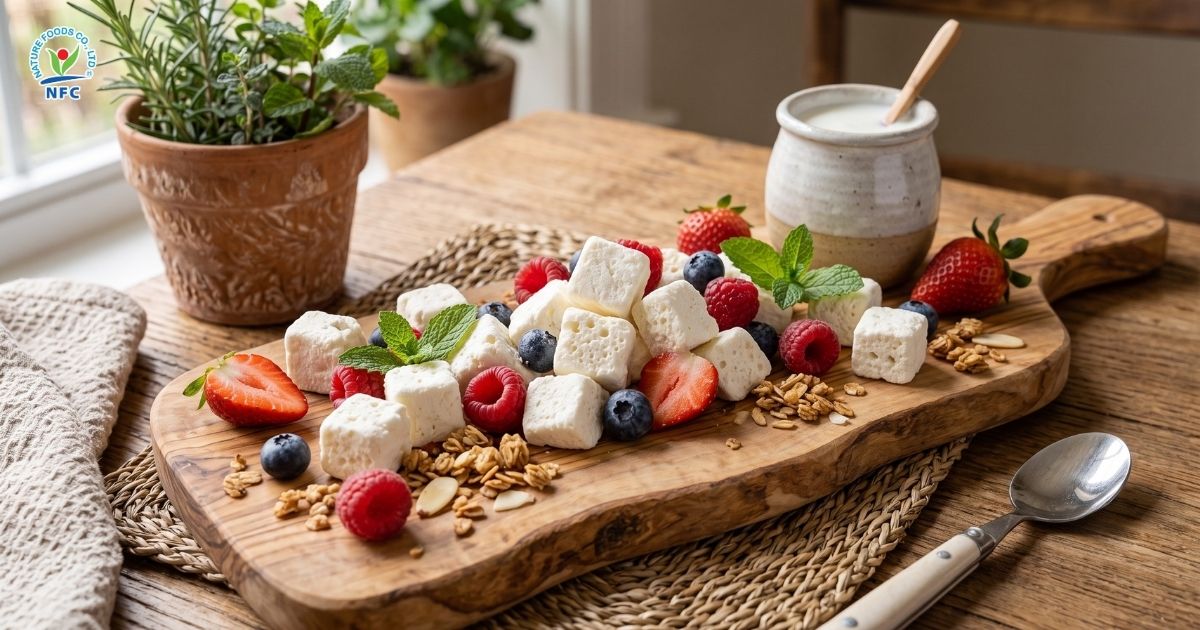
Instead of relying on standard thermal evaporation workflows that deploy intense heat to extract moisture—which heavily damages delicate milk proteins and alters product properties—advanced freeze-drying technology anchors processing on low-temperature phase changes. The formulated yogurt blocks undergo deep rapid freezing to lock molecular structures in position. Upon entry into an hermetically sealed absolute vacuum chamber, radiant shelf heating supplies controlled energy, driving the locked ice crystals to sublimate directly into gaseous vapor without ever transforming into a liquid phase. This absolute circumvention of liquid water prevents cellular shrinkage, resulting in a unique, ultra-lightweight dehydrated matrix.
From a Smooth Fluid State to a Brittle, Porous Crunchy Texture
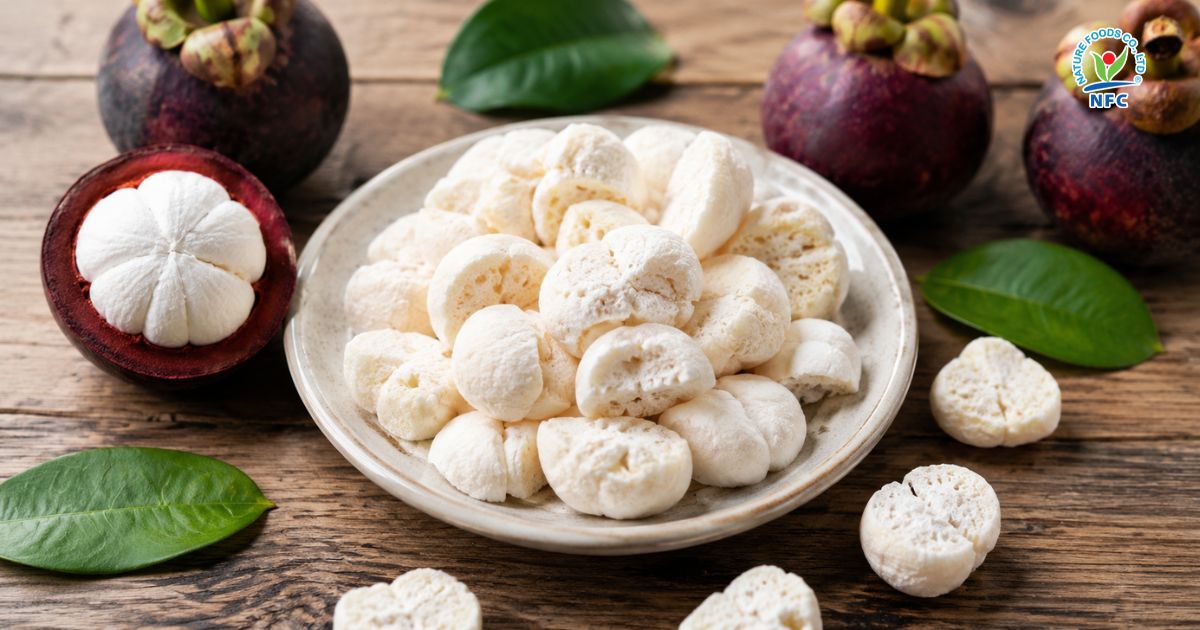
Following the completion of the freeze-drying cycle, the yogurt sheds its original viscous fluid profile to claim a bone-dry, highly porous interior geometry filled with thousands of microscopic voids. This delicate honeycomb structure yields an instantaneous melt-in-the-mouth crispness that represents a brilliant sensory shift from traditional dairy formats.
This technical configuration anchors the design of our premium I.Yaua freeze-dried yogurt drops, allowing the blocks to deliver an excellent crunchy bite before dissolving smoothly on the tongue, completely eliminating cold warehouse dependencies during retail placement.
Rigid Safeguarding of Authentic Fermented Flavors and Visual Tones
Operating entirely within low-temperature parameters devoid of atmospheric oxygen, the material is systematically protected from heat-induced chemical breakdown or flavor distortion. Freeze-dried yogurt perfectly preserves its clean lactic sourness, rich dairy creaminess, and the vibrant natural color notes of raw crop inclusions.
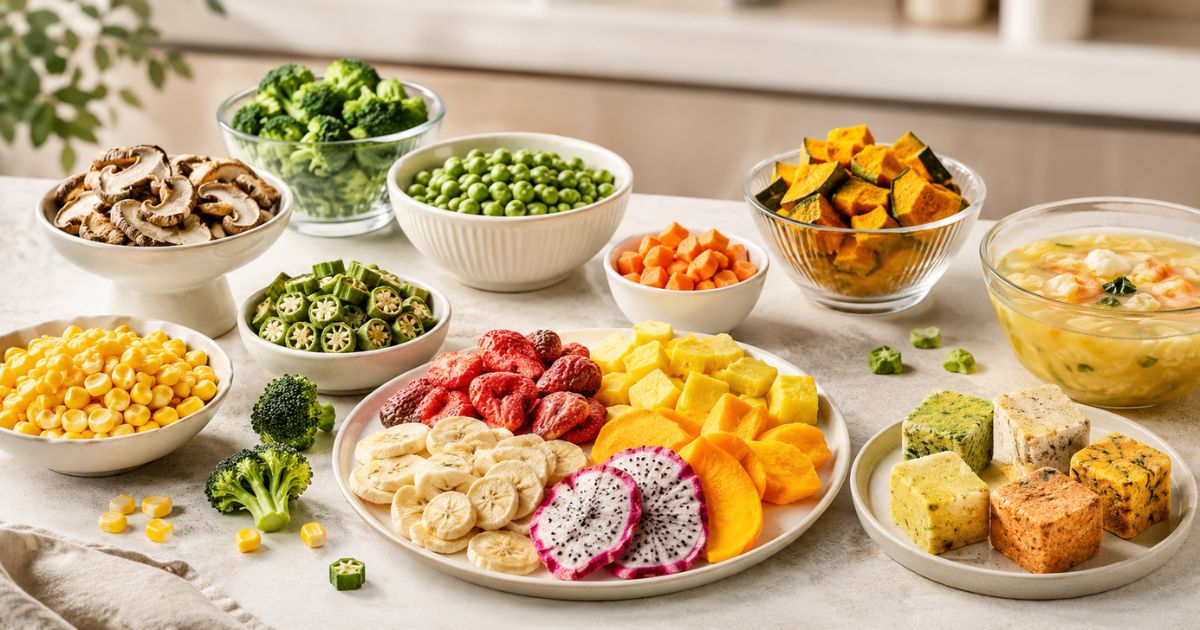
Beyond classical traditional milk bases, this food technology enables product development teams to easily incorporate versatile inclusions—such as strawberries, blueberries, white peaches, roasted nuts, or functional grains—to agilely multiply retail SKU options.
Instantaneous Rehydration Kinetics and Multi-Component Blending Versatility
Thanks to the uniform distribution of the microscopic internal voids, freeze-dried yogurt exhibits highly aggressive reverse-hygroscopic behavior (rehydration profiles). When enjoyed standalone by consumers or blended by industrial manufacturers into pre-mixed breakfast products (such as fiber-dense cereals or protein-heavy granolas), the dry yogurt drops require only fractions of a second to absorb moisture from surrounding liquids, instantly returning to a rich, creamy, and velvety fresh-like texture identical to an artisanal fresh yogurt hũ.
Locking Probiotics and Vital Nutrients into a Secure, Protected State of “Biostasis”
Past altering outer visual profiles, industrial freeze-drying compresses residual batch moisture deep below optimal targets (<5%), causing active probiotics to enter a temporary, highly stable state of biostasis or “hibernation.”
The dry, porous protein matrix surrounding the micro-organisms acts as a protective shield, protecting the delicate live cultures from oxidation and atmospheric humidity. Thanks to this protective structure, the beneficial live cultures can survive for extended periods under normal ambient conditions.
The moment the product passes into the digestive tract and encounters proper physiological moisture, the probiotics instantly wake up, reactivating their metabolic paths to support intestinal wellness, ensuring the final lot delivers the exact biological value of fresh fermented dairy.
Supply Chain Economics and Operational Standardization: The Ultimate Moat for B2B Food Manufacturers
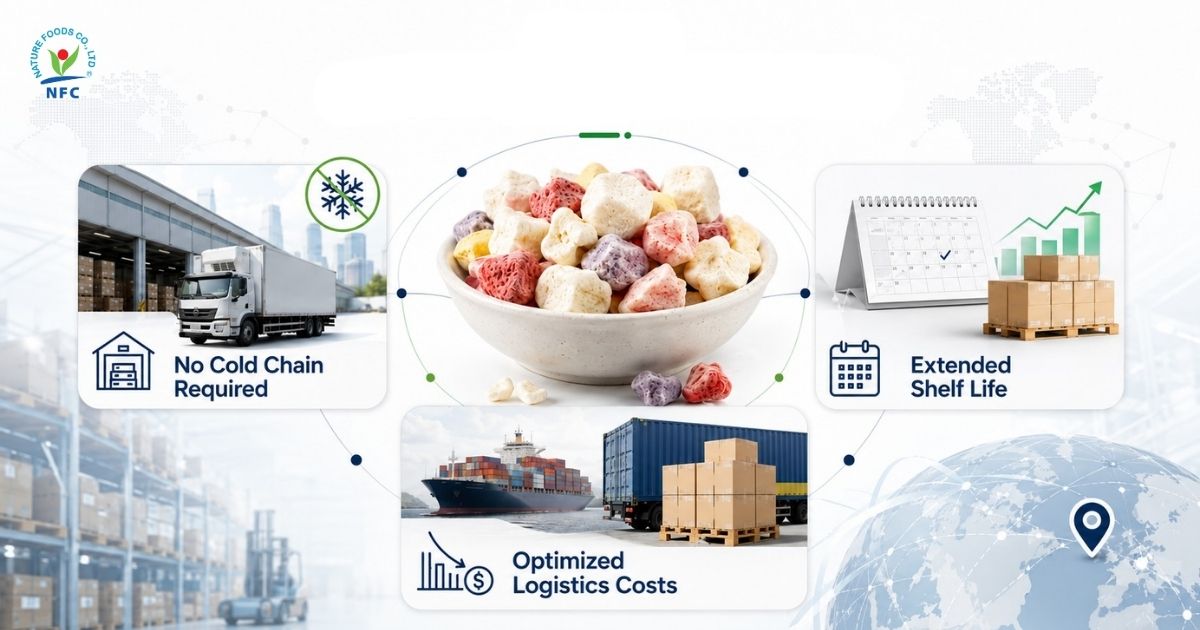
For procurement directors, warehouse administrators, and logistics managers within corporate F&B groups, integrating freeze-dried yogurt formats yields strategic economic advantages:
-
Eradicating Cold Chain Logistics Overhead (Zero Cold Chain Required): Your enterprise can entirely eliminate variable costs tracking refrigerated truck transit fleets, dedicated storefront cold cases, and climate-controlled shipping logistics. Freeze-dried yogurt merely requires placement within standard, dry ambient warehouse facilities.
-
Highly Extended Shelf Preservations and Working Capital Optimization: The stable merchant lifespan of freeze-dried lots is dramatically multiplied, safely spanning 12 to 18 months or longer depending on custom container matrices. This extended lifecycle drives product waste and close-to-expiration write-offs down to near-zero margins, allowing purchasing teams to smoothly balance production cadences against raw milk crop seasonality.
-
Immaculate Freight and Freight Transportation Optimization: Extracting up to 80% to 90% of unbound water mass results in an ultra-lightweight material output. Plant crews can pack and stack pallets at high densities, maximizing shipping container volumetric utilization and significantly slashing per-unit transportation costs (Unit Cost), particularly during long-distance maritime shipping schedules.
Critical Parameters for Enterprises Devising Private Freeze-Dried Yogurt Portfolios
Custom Formula Engineering Calibrated to Target Demographics
Every targeted retail demographic demands explicit adjustments regarding viscosity baselines, crop blending ratios, and physical particle dimensions. For instance, freeze-dried yogurt drops intended for infant weaning prioritize soft, rapid-melting traits and approachable flavor notes, whereas formulations engineered for adult fitness lines heavily anchor focus on dense nutrient delivery, minimal sugars, and higher raw protein metrics.
Operating under a flexible, comprehensive ODM partnership model, Nature Foods is fully equipped to guide your brand through advanced raw ingredient research and custom formula customization. Our technical tenure developing the landmark I.Yaua freeze-dried yogurt collection guarantees that our floor engineers can smoothly balance active lactic acids with complex additions like freeze-dried fruit inclusions or crunchy grains, accelerating your time-to-market.
Rigid Floor Oversight of Chamber Parameters to Prevent Structural Defects
Yogurt constitutes a highly complex food matrix, stacking delicate milk proteins, active lactose sugars, and sensitive milk fats simultaneously. Failing to expertly balance the temperature profiles and vacuum gradients across the multi-stage dehydration sequence can cause severe structural errors, including cell wall collapse, surface vitreous hardening that blocks dissolution, or massive probiotic degradation due to thermal shock.
At the centralized industrial complexes of NFC, every single stage—from flash tunnel freezing velocity, deep vacuum pressure thresholds, to secondary desorption heat supply—is directed via automated programmable logic controls, guaranteeing absolute multi-batch lot uniformity (Batch-to-Batch Consistency).
Securing High-Standard International Quality Accreditations Right from R&D Phases
To ensure your product lines seamlessly enter dominant domestic supermarket chains (MT networks) or confidently clear strict technical trade barriers in premium global trading zones—including Japan, North America, and the European Union—the manufacturing facility must run an uncompromising quality control architecture. The entire processing and contract manufacturing pipelines at Nature Foods are strictly monitored and operated under the world’s most elite certification matrix: BRCGS, ISO 22000, HACCP, FDA, HALAL, GLOBALG.A.P., and SEDEX – SMETA.
This robust quality infrastructure guarantees that Nature Foods comprehensively satisfies the compliance audits enforced by multi-national food brands, institutional distribution agencies, and export clearance desks.
Selecting a Contract Processing Partner with Scalable, Long-Term Sourcing Visibility
A highly successful retail launch demands that your production partner possess extensive manufacturing boundaries to seamlessly absorb unexpected volume surges without delay. Operating a versatile plant footprint capable of outputting a broad catalog of over 300 processed items, our facility floor hits a maximum designed capacity exceeding 3,000 tons of finished lot output annually.
Nature Foods behaves far beyond basic toll dryers, acting as your committed, long-range B2B strategic ally—actively supporting your corporate roadmap from initial custom trial runs (Trial Run) down to continuous automated mass manufacturing (Mass Production).
Conclusion
The industrial transition of yogurt from a highly volatile, short-lived cold chain dairy category into an ultra-convenient, crispy, and shelf-stable freeze-dried snack format stands as clear real-world proof of global F&B trends: accelerating custom nutrition profiles while heavily optimizing supply chain logistics architectures. Freeze-drying technology systematically dismantles persistent warehousing constraints for volume distributors, while providing a versatile canvas for R&D engineers to author innovative, wholesome clean-label product ranges tailored perfectly to the values of modern wellness shoppers.
For agile consumer food brands, this represents the definitive golden window to establish market share within high-margin, unsaturated niches—such as premium export-grade baby weaning foods or convenient on-the-go probiotic snack lines. Deploying a custom, private-label freeze-dried yogurt portfolio operates as an excellent strategic asset to step up gross profit margins and build distinct, uncopiable brand identity across retail shelves.
If your executive division is seeking a breakthrough operational path to bring a unique private line of freeze-dried yogurt creations to life, connect directly with the specialized B2B contract manufacturing advisors and R&D food scientists at Nature Foods (NFC) today. Our divisions are fully prepared to guide your team through an integrated partnership path, streamlining your launch from the first micro lab-scale validations down to high-volume commercial market domination.
Frequently Asked Questions About Freeze-Dried Yogurt Wholesale & Contract Manufacturing (FAQ)
1. Freeze-dried yogurt exhibits highly rapid reverse-hygroscopic behavior; what are the mandatory handling protocols following bulk containment opening?
Technical Solutions via NFC Engineering: Due to the preservation of an open, honeycombed cell structure post-sublimation, freeze-dried matrices act as highly aggressive micro-sponges, rapidly pulling moisture from surrounding air upon ambient exposure. Recognizing this, all consumer SKUs or raw material bulk lots shipped by NFC are strictly enclosed within multi-layered aluminum barrier packaging engineered to block oxygen transmission, humidity migration, and light degradation.
For bulk ingredient shipments destined for secondary food processing complexes, materials are securely packed inside thick aluminum bulk bags backfilled with food-grade inert gas and housed within standard sturdy boxes. Following seal de-preservation on your factory floor, handling workflows should strictly take place inside relative humidity-controlled cleanrooms (RH < 40%), with bag closures or industrial sealings re-applied immediately after portioning. The material is safely stored at ambient room temperature, requiring zero cold storage infrastructure.
2. What are the specific parameters governing product customization under NFC’s OEM/ODM service models?
- Formula & Flavor Canopy: Complete flexibility to blend our authentic fermented yogurt base with premium fruit powders, real freeze-dried fruit inclusions (such as strawberry wheels, whole blueberries, diced mangoes, or durian bits), organic nutraceutical botanicals, or healthy grains.
- Geometric Particle Sizing: Advanced cleanroom extrusion cutting to output uniform cubical forms (cubes), mini spheres, droplet silhouettes (drops), or processed down to custom diced granules engineered as functional inclusions for infant formula or chocolate lines.
- Physicochemical & Probiotic Indexing: Regulating final residual moisture borders strictly below 5% while configuring live target probiotic colony-forming units (CFUs) to satisfy private clean-label and nutritional declarations seamlessly.
- Integrated Packaging Formats: Turnkey support for multiple layouts, spanning single-serve barrier sachets, flexible stand-up zipper pouches, clear airtight PET jars, or volume bulk boxes (Bulk Production) to feed large industrial production lines.
3. What is the Minimum Order Quantity (MOQ) policy governing private label freeze-dried yogurt contract processing at NFC?
Master MOQ indexes at Nature Foods are computed adaptively, reflecting the mechanical complexity of your formula, chosen packaging specifications, and individual project criteria.
NFC proudly shields your capital and optimizes cash flow velocity by structuring our industrial cooperation into phased roadmap milestones: actively supporting your team from initial lab-scale formula validation runs (Lab Scale), moving into pilot-scale market validation batches (Pilot Scale) to test consumer feedback, prior to initiating long-term high-volume commercial contracts (Mass Production).
4. For how long can the live probiotic culture count be guaranteed within freeze-dried yogurt stored at room temperature?
By inducing a highly stable state of metabolic biostasis through deep moisture removal (<5%) and protecting live cells within a rigid protein matrix shell, core starter cultures (including Lactobacillus bulgaricus and Streptococcus thermophilus) comfortably maintain standard living population counts throughout the product’s entire lifespan (12 to 18 months) under ambient warehouse conditions (strictly below 30°C).
NFC’s testing laboratories execute continuous stability testing (Stability Testing) tracking live colony counts across every production run to ensure that at the final point of retail consumption, the lot supplies the verified digestive efficacy of fresh artisanal yogurt.
5. Do freeze-dried yogurt lines contract manufactured by NFC clear rigid regulatory parameters for entry into major global markets?
Yes, absolutely. The complete processing loop—from raw fresh milk input screening to vacuum tunnel extraction sequences inside our cleanrooms—is tightly audited under world-class quality systems.
Nature Foods holds an uncompromised portfolio of dominant global quality accreditations required for customs entry: BRCGS (Global Standard for Food Safety), ISO 22000, HACCP, valid FDA facility registrations for the US market, full HALAL portfolios for Islamic nations, paired with strict corporate social responsibility and traceability data compiled under GLOBALG.A.P. and SEDEX – SMETA. This rigorous compliance grid operates as an elite trade passport helping your private brands clear customs checkpoints and land premium shelf space inside top-tier global retail groups seamlessly.
6. What is the core differentiator regarding variable operational expenditures between liquid fresh yogurt and freeze-dried alternatives?
The defining differentiator centers on eliminating cold supply chain overhead liabilities and mitigating close-to-date inventory waste. Liquid fresh dairy forces enterprises to absorb massive variable costs tracking refrigerated truck logistics, dedicated retail chilling display cases, and severe write-off risks due to narrow 30-to-60-day lifespans.
Conversely, freeze-dried yogurt entirely frees your business architecture from climate-controlled transport constraints (Zero Cold Chain Required). An extended 12-to-18-month commercial life drives product expiration write-offs down to absolute zero. Concurrently, stripping out 80% to 90% of unbound water mass results in an ultra-lightweight material profile, optimizing box density per pallet to drastically trim your per-unit freight and export shipping expenses (Unit Cost).