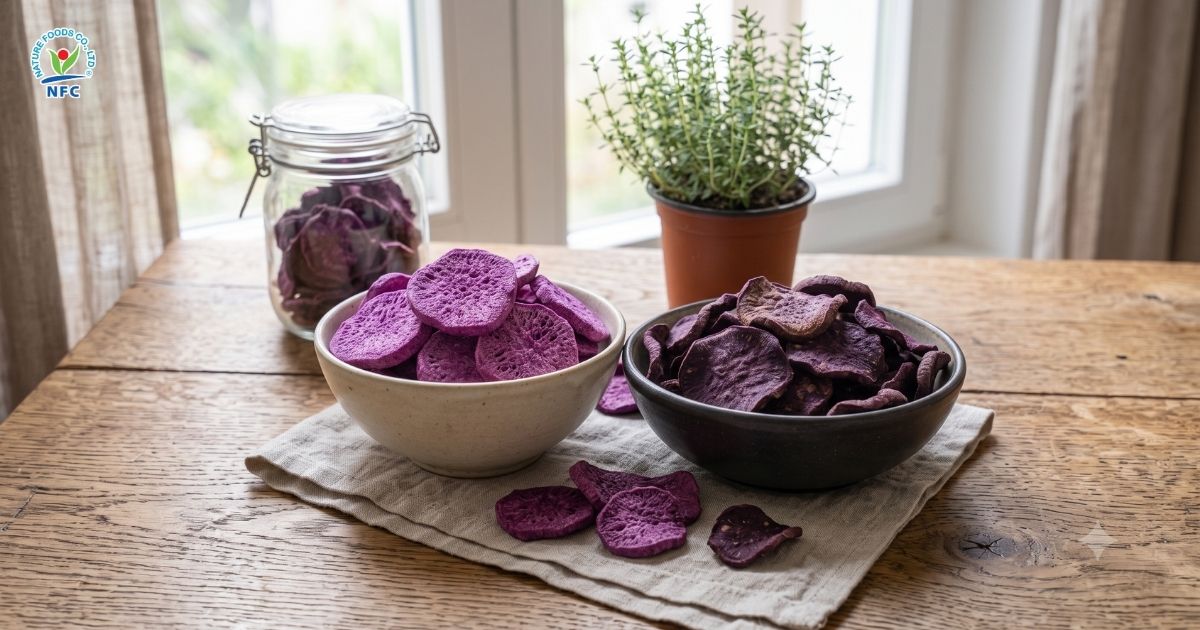
Across modern commercial food processing, culinary hospitality, and consumer packaged goods (CPG) manufacturing, industrial cooking seasoning powders are engineered into specialized functional categories based on raw agricultural inputs, aromatic volatile retention, and target formulation dynamics. From artisanal commercial restaurant chains and central commissary kitchens to high-capacity multinational food processing facilities, the deployment of standardized spice and seasoning powders delivers the agility required to formulate complex savory profiles at scale.
The industrial transition from raw, perishable agricultural produce to standardized, free-flowing dry powders represents a strategic evolution in supply chain management. This operational shift enables food processors to standardize signature flavor profiles across multi-ton manufacturing batches, completely eliminate perishable organic waste, lower warehouse footprint expenditures, and significantly reduce overall operational and logistics costs.
Classification of Commercial Cooking Seasoning Powders in Food Processing
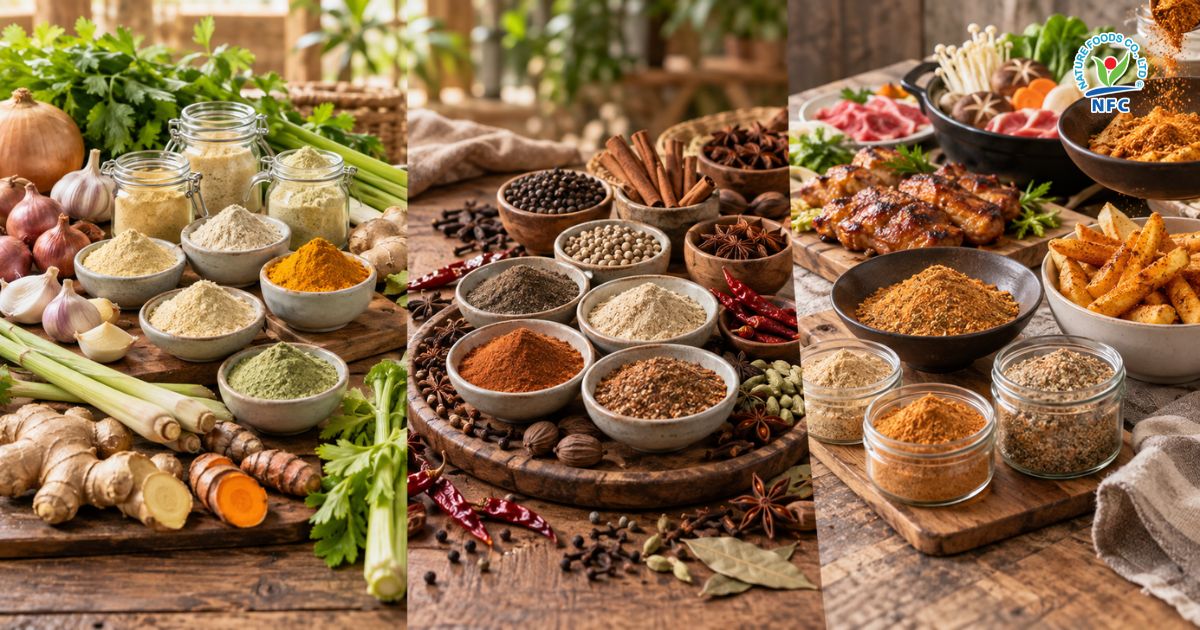
1. Natural Allium & Vegetable Seasoning Powders
Allium and vegetable seasoning powders are manufactured from fresh edible roots, bulbs, tubers, and leafy vegetable crops that undergo multi-stage aqueous sanitization, mechanical slicing, controlled thermal dehydration, and precision fine milling. Core industrial staples in this category include pure garlic powder, onion powder, shallot powder, ginger powder, turmeric powder, lemongrass powder, scallion powder, and celery powder.
-
Functional Role in Food Formulation: Vegetable powders serve as the foundational savory building blocks across commercial food matrices. Rich in naturally occurring glutamates, sulfurous aromatic compounds, and complex carbohydrates, they impart authentic background depth, round out harsh acidic notes, and deliver savory body (kokumi) to retorted sauces, meat marinades, canned meat and fish, instant noodle seasoning sachets, extruded snack slurry coatings, and prepared convenience meals.
-
Operational & Economic Manufacturing Advantages: Raw alliums and fresh vegetables carry high natural moisture contents (75% to 90%), making them vulnerable to mechanical bruising, post-harvest mold decay, sprouting, and seasonal commodity price volatility. Transitioning to dehydrated vegetable powders provides an extended ambient shelf life of 12 to 24 months, permanently eliminates refrigerated cold-storage expenditures, reduces warehouse cubic footprint requirements, and allows plant technicians to achieve exact gravimetric dosing via automated pneumatic scaling systems without batch-to-batch flavor deviation.
2. Natural Herb, Spice & Botanical Aromatic Powders
Beyond vegetable bulbs, botanical spices rich in volatile essential oils and lipophilic oleoresins—including black pepper, white pepper, cinnamon, star anise, cardamom, whole dried chilis, cloves, and traditional five-spice blends—are dried and milled to precise particle granulometry curves.
-
Organoleptic & Physicochemical Properties: Industrial processing preserves the natural pungency, volatile aromatic terpene profiles, and rich pigmentation derived from native botanical compounds (such as piperine in pepper, cinnamaldehyde in cassia, and capsaicinoids in chili peppers). Operating low-temperature grinding systems protects these volatile oils from frictional heat degradation and oxidative volatilization.
-
Processing Performance in Industrial Matrices: When incorporated into protein emulsions (sausages, hot dogs, meatballs), seafood surimi, topical snack dustings, or bottled savory condiments, fine-milled botanical powders ensure uniform dispersion. Their calibrated particle surface area enables rapid oil and water absorption, preventing clumping, eliminating localized “hot spots” of intense pungency, and integrating smoothly with automated dry ribbon blenders and continuous industrial tumble-coaters.
3. Customized Proprietary Seasoning Blends & Topical Rubs
Unlike single-ingredient raw spice powders, customized blended seasoning powders represent complex, multi-component systems combining standardized spices with food-grade sea salts, functional sugars (dextrose, sucrose), yeast extracts, savory hydrolyzed vegetable proteins (HVP), natural meat powders, and anti-caking texturizers calibrated to proprietary ratios.
-
Commercial Product Formulations: High-demand industrial formulations include customized barbecue (BBQ) meat rubs, dehydrated hot pot broth bases, instant bouillon seasoning cubes, functional seasoning dusts for potato chips and extruded corn snacks, and specialized salt seasoning lines (such as shrimp salt, chili salt, and lemongrass pepper salt).
-
Strategic Brand Differentiation & Market Moats: Proprietary blended seasoning systems provide multi-unit restaurant chains, central commissary kitchens, and industrial food brands with a turnkey solution to standardize their signature flavor profiles across domestic and global franchises. Pre-blended seasoning systems compress kitchen prep cycles, eliminate ingredient scaling errors across factory shifts, and protect proprietary recipe IP through centralized contract manufacturing.
Key Evaluation Criteria for Selecting a B2B Seasoning Powder Contract Manufacturer
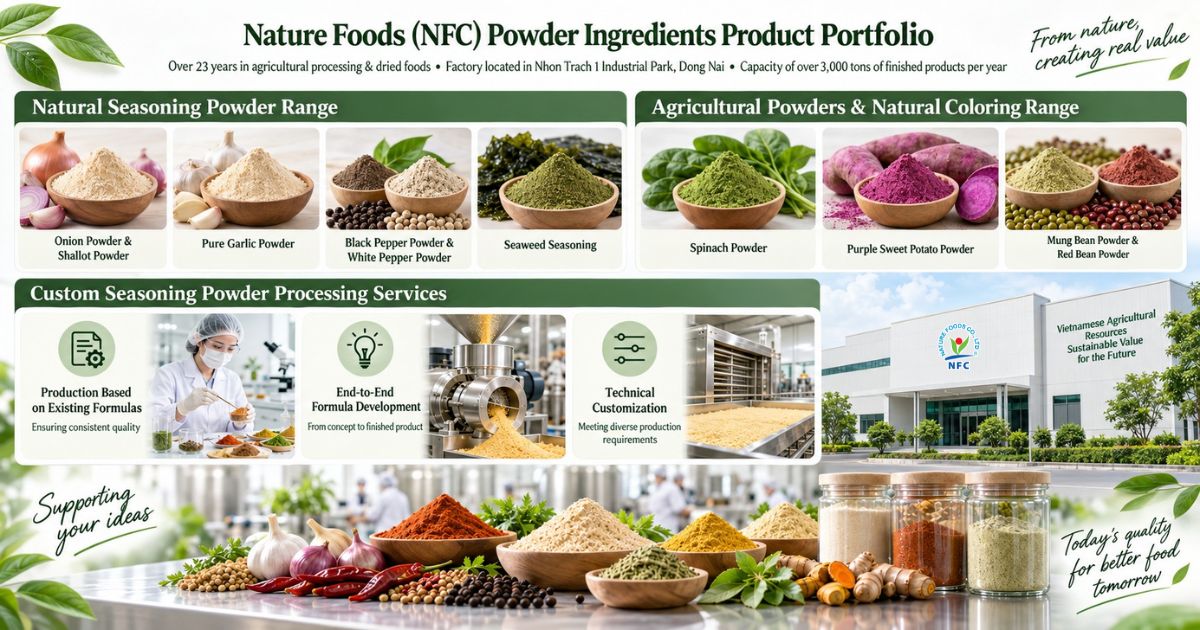
For commercial food processors, restaurant chain operators, and FMCG procurement divisions, selecting a contract manufacturing partner (OEM/ODM) extends far beyond comparing bulk price quotes. Seasoning powders represent the sensory core that dictates the color, aroma, palatability, and consumer repurchase rate of the finished product. Furthermore, spice powders directly impact factory automation; an unmanaged variation in residual moisture, bulk density, or mesh fineness can cause hopper bridging, screen blinding, and line blockages in automated packaging systems, resulting in costly equipment downtime and brand risk.
To establish a secure, long-term commercial partnership, corporate procurement teams and food science R&D directors must evaluate contract processors against five fundamental technical benchmarks:
1. Turnkey Culinary R&D, Laboratory Prototyping & Intellectual Property Protection
Every successful food brand relies on a signature flavor profile that differentiates its products on retail shelves. Procuring generic, off-the-shelf spice mixes from commodity trading intermediaries leaves brands vulnerable to recipe imitation by competitors while offering zero formulation customization.
-
Food Science & Culinary Interaction Expertise: The manufacturing partner must employ specialized food scientists and flavor chemists who understand the thermodynamic and chemical interactions between spices during commercial processing. For instance, the ratio of allium powders (garlic, onion) to capsicums and ground peppers must be calibrated to ensure balanced aromatic release without masking the primary protein or vegetable base.
-
Transparent R&D Pilot Prototyping: An experienced contract processor provides structured sampling protocols rather than pushing for immediate mass-scale production commitments. They support multi-stage pilot sample iterations (100g to 1kg trial batches), dispatching prototypes directly to the client’s test kitchens or sensory evaluation laboratories for real-world cooking, baking, and retort stability testing.
-
Enforceable Non-Disclosure & Recipe Confidentiality Agreements: Proprietary spice formulas constitute vital corporate intellectual property. A reputable contract processor enforces rigorous confidentiality agreements (NDAs) and internal access controls to safeguard proprietary mixing ratios, ensuring exclusive recipe ownership for the brand client.
2. Precision Particle Granulometry & Low-Temperature Cryogenic Milling
When seasoning powders are dispersed into high-speed liquid mixers, dry rubs, or snack dusting applicators, particle size distribution (mesh granulometry) dictates dissolution rates, suspension stability, and sensory mouthfeel.
-
Custom Particle Mesh Sizing by Application: Different food matrices require distinct particle profiles. Instant noodle soup bases, clear broths, and emulsified liquid sauces demand ultra-fine powders (80 to 120 mesh) that disperse instantly without gritty residue. Conversely, topical snack seasonings, meat rubs, and pizza garnishes require coarse ground meals or granular flakes (20 to 40 mesh) to deliver visual texture, surface adhesion, and localized bursts of flavor.
-
Low-Temperature Milling to Prevent Thermal Degradation: Spices and alliums contain volatile aromatic essential oils that degrade under friction-induced heat. Legacy high-speed hammer mills can generate chamber temperatures exceeding 70°C, scorching delicate spice particles, darkening natural colors, and evaporating volatile aroma compounds. Qualified processors utilize temperature-controlled pin mills or cryogenic liquid nitrogen grinding systems that maintain cool milling environments, preserving the authentic aromatic profile and vibrant color of the raw agricultural inputs.
3. Controlled Dehydration, Water Activity ($a_w$) Management & Anti-Caking Performance
Moisture absorption and severe powder caking during storage present persistent operational challenges in seasoning powder handling, particularly for hygroscopic materials like pure garlic and onion powders.
-
Thermodynamic Moisture & Water Activity ($a_w$) Isolation: Qualified manufacturing facilities utilize automated convective dryers or vacuum freeze dryers to drive residual moisture below 6.0% and water activity ($a_w$) strictly below 0.30. Within this dry thermodynamic boundary, free moisture is unavailable to support microbial proliferation, mold germination, or enzymatic degradation, enabling 12 to 24 months of ambient shelf life without chemical preservatives.
-
Eliminating Packaging Hopper Clogging: Free-flowing powders with low moisture contents and controlled bulk densities flow smoothly through automated vertical form-fill-seal (VFFS) machines, multi-head auger fillers, and pneumatic conveying lines. This prevents nozzle bridging, reduces weight variance across single-serve sachets, and minimizes equipment stoppages on high-speed factory lines.
4. Industrial Plant Scale, Sourcing Security & Long-Term COGS Stability
Agricultural commodities are naturally subject to crop harvest seasonality, weather anomalies, and market price volatility. Partnering with an industrial-scale manufacturing plant insulates brand supply chains from sourcing disruptions:
-
Continuous Supply Assurance: Smaller processing operations often experience raw material stockouts or capacity bottlenecks during seasonal production surges (such as Lunar New Year or holiday retail peaks). An industrial facility operating thousands of square meters of warehouse space and multi-thousand-ton annual throughput maintains substantial safety stock reserves, fulfilling urgent, high-volume orders on schedule.
-
Cost of Goods Sold (COGS) Hedging: Industrial processors leverage centralized procurement programs during peak crop harvests, sourcing directly from audited agricultural zones under contract farming models. Combined with vertically integrated in-house cleaning, drying, and milling lines, this scale allows contract processors to offer fixed multi-quarter pricing, shielding brand partners from short-term commodity price spikes.
5. Audited International Food Safety Certifications & Analytical Traceability
Seasoning powders are direct-consumption food ingredients incorporated into high-risk formulations. Sourcing partners must maintain verified global food safety management systems to ensure compliance with international regulatory standards.
-
Physical, Chemical & Microbiological Screening: Every production lot must pass through high-intensity magnetic traps, vibratory sieves, and dual-frequency digital metal detectors. Batches undergo rigorous laboratory analysis to verify absence of heavy metals (Lead, Cadmium, Arsenic, Mercury), mycotoxins (Aflatoxins B1/B2/G1/G2, Ochratoxin A), illegal azo dyes (Sudan dyes), pesticide residues, and foodborne pathogens (Salmonella, E. coli, Listeria).
-
Global Export Compliance Passport: Manufacturing facilities certified under BRCGS (Global Standard for Food Safety), ISO 22000, HACCP, US FDA registration, HALAL, and SEDEX-SMETA social compliance provide recognized quality assurance. Every export shipment is accompanied by complete technical documentation—including Certificates of Analysis (CoA), Technical Data Sheets (TDS), and safety documentation—facilitating customs entry into demanding import markets across North America, the European Union, Japan, South Korea, and the Middle East.
Industrial Seasoning Powder Product Catalog at Nature Foods (NFC)
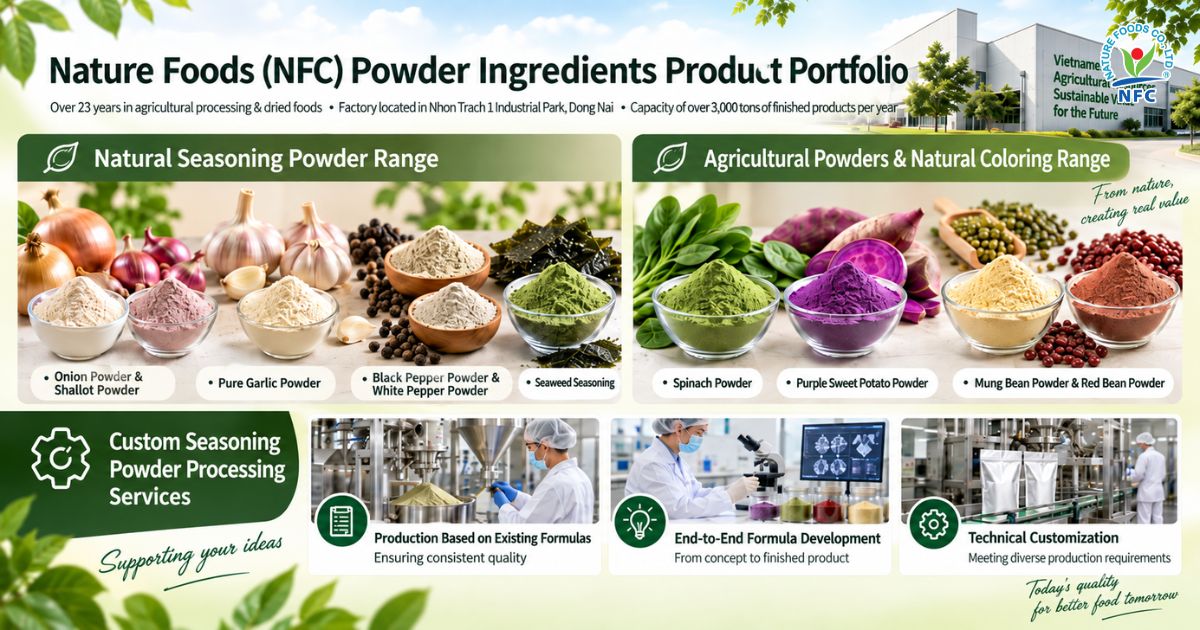
With over 23 years of specialized expertise in agricultural processing and food dehydration, operating an advanced processing complex in Nhon Trach 1 Industrial Zone (Dong Nai Province, Vietnam) with an annual capacity exceeding 3,000 to 4,000 metric tons, Nature Foods provides a comprehensive portfolio organized into two core categories:
1. Natural Savory Seasoning & Allium Powders:
-
Dehydrated Onion & Shallot Powder: Delivers concentrated sweet-savory allium aroma, providing foundational umami for dry ramen soup sachets, canned gravies, emulsified sausages, and snack coatings.
-
100% Pure Garlic Powder: Free-flowing, non-caking powder retaining authentic allicin-derived pungency without carriers, artificial flavorings, or chemical anti-caking agents.
-
Black Pepper & White Pepper Powder: Milled from selected high-density peppercorns harvested in the Central Highlands of Vietnam, standardized for piperine potency and warm aroma.
-
Natural Seaweed Seasoning: Imparts clean, marine umami notes, widely formulated into plant-based vegetarian foods, savory broths, and extruded rice snacks.
2. Agricultural Powders & Natural Botanical Colorants:
-
Pure Spinach Powder: Provides stable, vivid natural green chlorophyll coloration and dietary fiber for vegetable noodles, extruded snacks, and baby food premixes.
-
Purple Sweet Potato & Purple Yam Powder: Retains natural purple anthocyanin pigments, widely used in bakery doughs, pastry fillings, dessert puddings, and beverage premixes.
-
Mung Bean Powder & Red Bean Powder: Available in both raw starch grades (for bakery pastes, dumplings, and meat binders) and pre-cooked roasted formats (for instant beverages and multigrain nutrition drinks).
Turnkey B2B Contract Manufacturing & Custom Blending Services
Beyond standard catalog ingredients, Nature Foods provides end-to-end OEM, ODM, OBM, and White Label contract manufacturing solutions for domestic and international brands:
-
OEM Manufacturing According to Client Recipes: Commercial partners provide their proprietary recipes and quality targets; Nature Foods executes raw crop sourcing, cleaning, dehydration, milling, and precision packaging under strict quality protocols.
-
Turnkey ODM Recipe Formulation: Food science engineers at Nature Foods collaborate with client teams to develop custom spice blends, balance savory profiles, optimize unit COGS, and manufacture pilot trial prototypes.
-
Custom Particle Granulometry & Packaging Formats: Particle sizing is adjustable from ultra-fine powders (80 to 120 mesh) for instant liquid dissolution to coarse meals and flakes (20 to 40 mesh) for topical dustings. Packaging configurations range from 20kg–25kg industrial multi-wall kraft paper sacks and aluminum barrier bags to private-label retail shaker jars, zipper pouches, and portioned single-serve sachets.
Frequently Asked Questions Regarding Seasoning Powders (FAQ)
1. Do Nature Foods’ seasoning powders contain synthetic chemical preservatives, artificial colors, or unapproved additives?
2. Can particle mesh size and bulk density be customized to match specific manufacturing equipment?
Yes, absolutely. Nature Foods operates multi-stage pin mills, cryogenic grinders, and vibratory sifting decks that allow precise calibration of particle size distributions:
- Ultra-Fine Powder (80 to 120 mesh): Engineered for rapid liquid dissolution and smooth mouthfeel, ideal for instant noodle soup sachets, dry bouillon mixes, and emulsified table sauces.
- Coarse Ground & Flaked Formats (20 to 60 mesh): Delivers visual spice presence, controlled flavor release, and surface adhesion, optimized for topical snack dusting, pizza crust garnishes, and barbecue meat rubs.
Bulk density (g/mL) can also be standardized to align with high-speed automated volumetric filling machinery.
3. What is the commercial shelf life of bulk seasoning powders, and what storage parameters prevent caking?
4. What is the Minimum Order Quantity (MOQ) for wholesale procurement or custom contract processing?
5. How does the R&D sample prototyping process proceed for commercial clients?
6. Does Nature Foods hold international food safety certifications to support global export clearance?
Commercial Sourcing & Partnership Inquiries: Food manufacturing enterprises, FMCG brand owners, and industrial distributors seeking custom seasoning formulation support, complimentary R&D pilot sample testing, or volume wholesale ingredient pricing are invited to connect directly with Nature Foods’ technical sales division for comprehensive engineering and supply chain support.