Broccoli is a highly regarded vegetable due to its rich nutritional profile, containing dietary fiber, Vitamin C, Vitamin K, Folate, and various natural antioxidants. However, it is also a highly perishable crop post-harvest. Shortly after harvesting, fresh broccoli rapidly loses its vibrant green color, crispness, and sensory quality if not stored under strict controlled conditions.
- Freeze-Dried Broccoli: Premium B2B Raw Material Solution for Food Enterprises
- Key Advantages of Industrial Freeze-Dried Broccoli
- Industrial Manufacturing Process for Freeze-Dried Broccoli
- Critical Evaluation Criteria for Selecting a Freeze-Dried Broccoli Contract Manufacturer
- Conclusion
- Frequently Asked Questions (FAQ)
Freeze-Dried Broccoli: Premium B2B Raw Material Solution for Food Enterprises
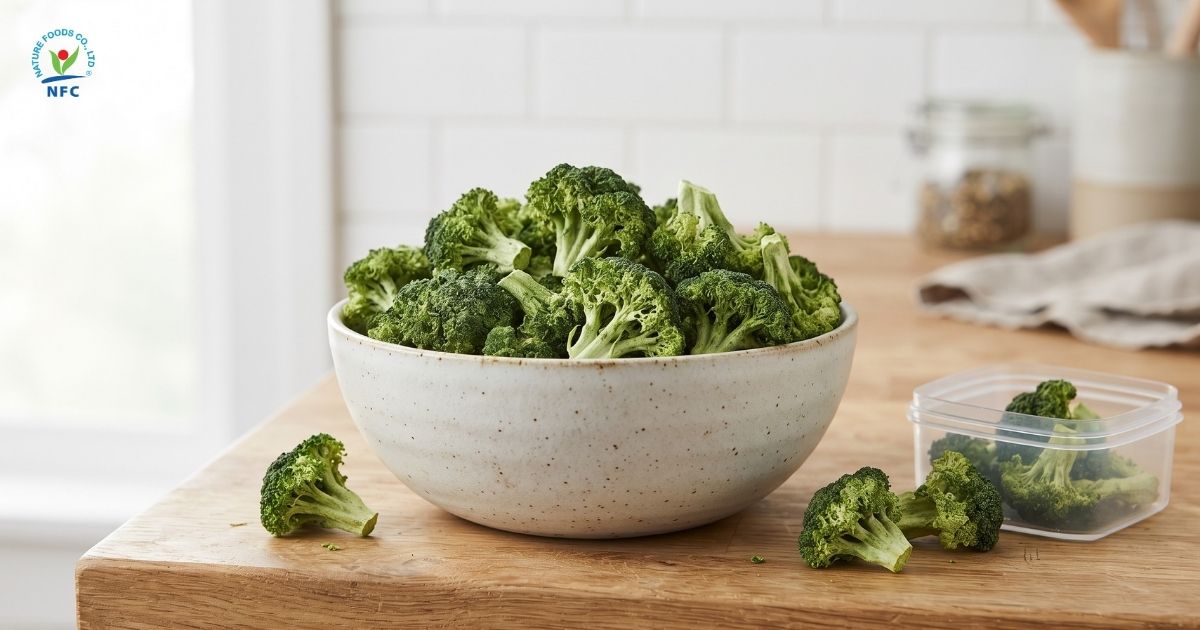
Across the food and beverage (F&B) processing industry, broccoli (calabrese) consistently stands as a premium vegetable ingredient prioritized for its superior nutritional density and appealing visual color. However, introducing raw fresh broccoli into large-scale industrial manufacturing pipelines introduces severe operational bottlenecks and logistics cost liabilities:
-
Extremely Narrow Shelf Life: Carrying high natural moisture (~89–90%) and an extensive surface area, post-harvest respiration rates in fresh broccoli occur rapidly. Under ambient room temperatures, fresh heads retain freshness for merely 3 to 5 days before experiencing yellowing, browning, or bacterial decay and mold growth.
-
Heavy Cold Chain Logistics Liabilities: To preserve quality, the entire supply chain—from farm harvesting and warehousing to long-haul freight transit—must be strictly maintained within refrigerated cold chains, inflating utility and transport expenditures significantly.
-
High Organic Yield Waste & Pre-Treatment Costs: Trimming tough fibrous stems, thick cores, and bruised leaves at processing plants incurs a massive raw material loss of 30% to 40%. Enterprises absorb high labor costs for manual pre-treatment while paying extra for organic waste disposal.
-
Sensory & Nutritional Quality Fluctuation: Prolonged storage or sub-optimal warehousing rapidly degrades chlorophyll pigments, denatures vitamins, and ruins the signature crispness of the florets.
Consequently, Freeze-Dried Broccoli has emerged as a game-changing solution empowering F&B enterprises to standardize raw material sourcing. In addition to extending shelf life to 12–24 months under room-temperature storage, this advanced sublimation technology perfectly preserves color saturation, 3D structure, authentic flavor, and vital bioactive compounds—helping brands optimize operating expenditures and secure competitive market moats.
Key Advantages of Industrial Freeze-Dried Broccoli
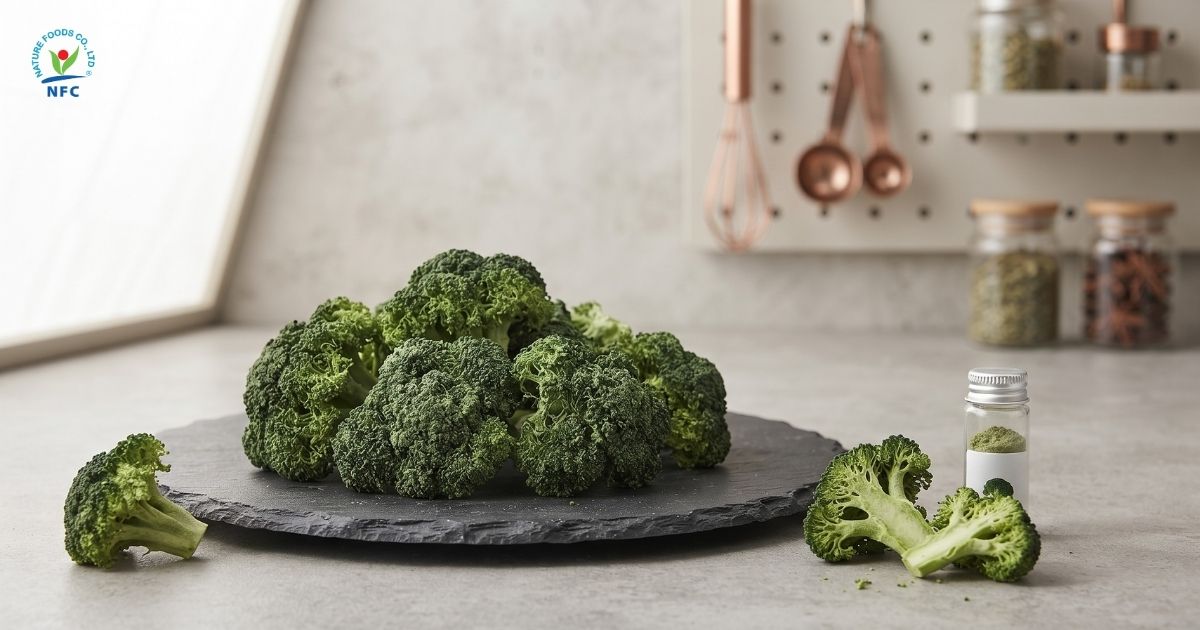
Vacuum freeze-drying technology (Freeze Drying – FD) stands out as the undisputed gold standard when sourcing processed broccoli ingredients. By sublimating ice crystals directly into vapor within absolute vacuum environments at deep sub-zero temperatures, FD technology overcomes the thermal destruction typical of conventional hot-air drying, yielding distinct commercial benefits:
1. Maximum Retention of Thermo-Sensitive Bioactive Compounds
Fresh broccoli contains high concentrations of Sulforaphane—a potent Isothiocyanate compound recognized for its powerful antioxidant and cellular protection properties. However, Sulforaphane, alongside Vitamin C, Folate, and Glucosinolates, is highly sensitive to high heat and degrades rapidly during hot-air dehydration.
-
Preserving 95%–98% of Native Nutrients: Bypassing liquid water phases and high thermal stress, freeze drying protects delicate vitamin linkages and essential bioactive compounds intact.
-
Elevating Finished Product Nutritional Value: Superior nutrient retention enables food brands to effortlessly satisfy strict label declaration standards for functional health foods, dietary supplements, and infant nutrition lines.
2. Maintaining Natural Chlorophyll Pigmentation – Clean Label Standard
The vibrant green visual hue of broccoli stems from natural chlorophyll pigments. Under high thermal processing, chlorophyll readily converts into pheophytin, causing vegetable tissues to turn dull yellow or brownish-green.
-
Authentic Bright Green Hue: Maintaining sub-zero temperatures throughout primary drying, vacuum freeze drying safeguards chlorophyll structures, ensuring the processed broccoli retains its fresh green color.
-
Fulfilling Clean Label Expectations: Brands avoid synthetic colorings or artificial additives entirely, delivering pristine visual aesthetics post-rehydration naturally.
3. Preserving 3D Cellular Structure & Floret Morphology
Unlike hot-air convection drying that induces severe cell wall collapse, tissue shrinkage, and morphological distortion, vacuum freeze drying locks cellular geometry from within:
-
Porous Biological Framework: Rapid freezing creates microscopic ice crystals that anchor cell structures. Upon sublimation, these crystals leave behind an interconnected micro-porous grid without tearing cell membranes or deforming floret shapes.
-
Minimizing Crushing & Fragmentation Loss: Floret shapes remain intact, satisfying high sensory standards for premium dried food products.
4. B2B Operational & Logistics Cost Optimization
Beyond sensory and nutritional parameters, freeze-dried broccoli delivers clear financial advantages across supply chain management:
-
Eliminating Cold Chain Storage Costs: Driving target residual moisture strictly below 5% enables stable ambient room-temperature storage for 12 to 24 months without risk of spoilage or microbial growth. Enterprises permanently cut out cold room electricity and maintenance bills.
-
Mass Freight Weight Reduction: Weight is reduced by 85% to 90% compared to fresh produce, significantly trimming freight fees calculated by weight and optimizing ocean container shipments.
-
Year-Round Sourcing Stability: Food processors decouple operations from crop seasonality, fixing baseline input costs and securing steady manufacturing schedules.
5. Superior Rehydration Kinetics
Owing to the porous honeycomb structure left post-sublimation, freeze-dried broccoli exhibits exceptionally fast liquid absorption rates:
-
Ultra-Fast Recovery to Fresh State: Soaking in warm or hot water for just 1 to 2 minutes allows freeze-dried broccoli to fully rehydrate, reclaiming its fresh color, 3D shape, and tender-crisp texture naturally.
-
High Compatibility with Convenience Foods: Rapid rehydration makes it an ideal fit for instant soups, noodle sachets, porridges, and meal kits requiring zero extended cooking.
6. Multi-Industry Application Versatility
Freeze-dried broccoli is easily customized across versatile particle sizes to match diverse food processing sectors:
-
Whole Florets (Florets): Ideal for gourmet soup packs, luxury meal kits, and premium instant noodle garnishes.
-
Diced Cubes / Slices (Diced/Sliced): Formulated into instant soups, ready-to-eat porridges, and infant weaning foods.
-
100% Pure Fine Powder (Broccoli Powder): Utilized as a natural green colorant, rice seasoning, functional infant biscuit ingredient, dietary supplement base, and fortified dairy formulas.
Industrial Manufacturing Process for Freeze-Dried Broccoli
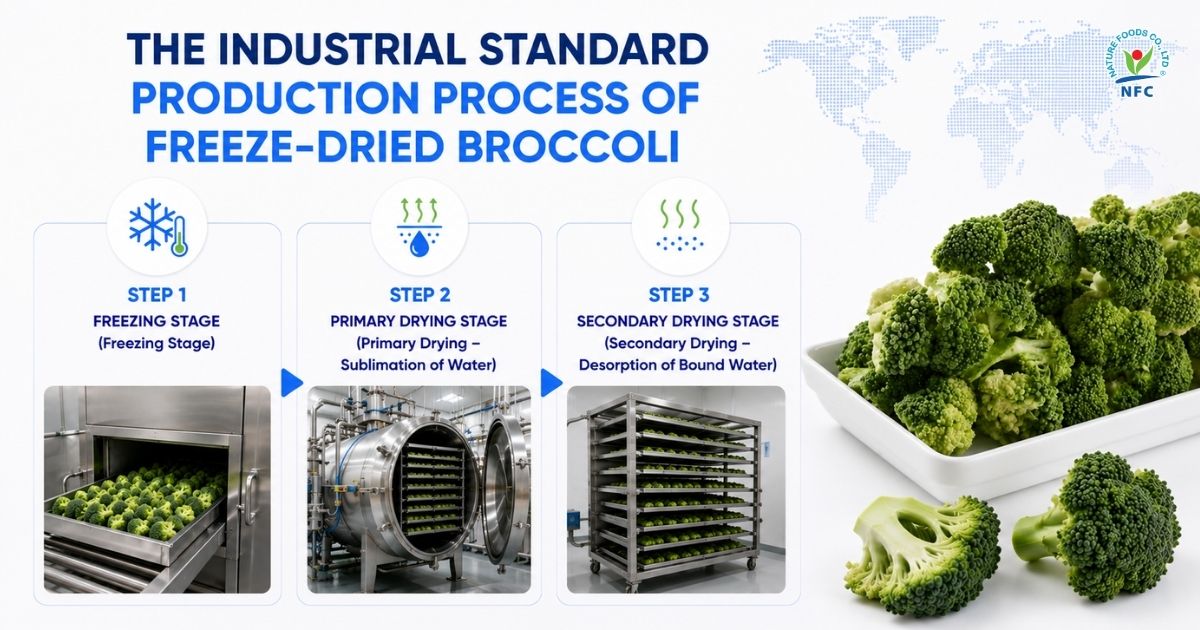
The industrial freeze-drying process (Freeze Drying – FD) for broccoli executes across three strictly controlled technical stages:
Stage 1 – Cryogenic Deep Blast Freezing (Freezing Stage)
Following washing and precision mechanical cutting, fresh broccoli immediately enters cryogenic flash freezing tunnels operating at sub-zero temperatures from -30°C to -50°C.
-
Generating Micro-Ice Crystals: Rapid freezing forces intracellular free liquid to solidify into microscopic ice crystals.
-
Protecting Cell Membranes: Micro-ice crystals anchor cell walls rigidly, preventing membrane tearing and protecting floret structural integrity.
Stage 2 – Primary Drying (Sublimation Phase)
Frozen broccoli moves into sealed vacuum drying chambers. High-vacuum pumps pull chamber pressure down below 1 mbar. Radiant heating plates gently introduce energy to trigger sublimation: solid ice converts directly into gaseous vapor without passing through a liquid state.
-
Preserving 3D Shape: Absence of liquid water prevents tissue shrinkage or cell collapse.
-
Safeguarding Chlorophyll & Bioactives: Cold processing temperatures preserve natural Chlorophyll pigments alongside heat-vulnerable Sulforaphane and Vitamin C. Approximately 90% of free water is extracted in this stage.
Stage 3 – Secondary Drying (Desorption Phase)
To desorb the remaining 10% of bound moisture trapped deep within cellular tissues, plate temperatures are incrementally stepped up to 20°C to 40°C under maximum vacuum.
-
Achieving Target Residual Moisture (< 5%): Drives water activity ($a_w$) down to safe thresholds ($a_w \le 0.3$), completely isolating microbial and mold growth.
-
Extended Ambient Storage: The finished crisp lot is packed in multi-layer aluminum barrier packaging, ready for 12 to 24 months of ambient warehousing without chemical preservatives.
Critical Evaluation Criteria for Selecting a Freeze-Dried Broccoli Contract Manufacturer
Broccoli possesses a complex structure: thin delicate floret heads that are heat-sensitive, paired with thick dense stems. Lacking processing experience easily leads to quality defects like “stems remaining moist while florets darken or fragment.” To ensure multi-batch lot uniformity and cost optimization, F&B enterprises should evaluate these core benchmarks:
1. Multi-Batch Consistency & Sensory Uniformity Across High Volumes
Precision control over temperature profiles, vacuum pressure, and drying curves is essential to preserve bright green coloration and structural integrity.
-
Technical Process Mastery: Tailoring drying algorithms to specific particle formats (florets, diced, powder), ensuring residual moisture consistently hits under 5% with minimal fragmentation.
-
Standardized Facilities & Global Accreditations: Production at Nature Foods (NFC) operates under strict audited quality systems: BRCGS, ISO 22000, HACCP, FDA, HALAL, GLOBALG.A.P., and SEDEX – SMETA. These credentials streamline custom verification and support smooth entry into global retail networks.
2. Technology Diversity to Optimize Cost of Goods Sold (COGS)
Target product tiers (Premium vs. Mass Market) demand specific processing setups to balance input COGS effectively.
-
Multi-Technology Ecosystem: Nature Foods operates synchronized Freeze Drying (FD), Air Drying (AD), and Microwave Drying (MD) lines.
-
Flexible Technical Advisory: Tailoring technical recommendations based on client category goals to optimize unit costs without compromising required sensory standards.
3. Full Turnkey Customization Capabilities (R&D & OEM/ODM)
Enterprises require agility regarding particle sizing, target moisture, and protective barrier packaging to align with plant SOPs.
-
Versatile Particle Formatting: NFC processes whole florets (Florets), diced cubes (Diced), thin slices (Sliced), or 100% pure fine powder (Broccoli Powder).
-
Turnkey OEM/ODM/White Label Support: Leveraging structured R&D workflows, NFC provides complimentary lab sample testing (R&D Samples) to lock specs prior to mass commercial manufacturing.
Conclusion
Once challenging to store and distribute due to short fresh shelf life, freeze-dried broccoli now serves as a strategic raw material empowering F&B brands to standardize ingredient supply, eliminate organic yield loss, and elevate product value.
Selecting the optimal dehydration technology and partnering with an accredited contract processing leader establishes a solid foundation for sustainable commercial success across high-margin food categories.
Commercial entities seeking complimentary R&D sample testing or wholesale B2B contract consultations for freeze-dried broccoli are invited to connect with Nature Foods:
-
Hotline: (+84) 251 3560 107
-
Email: mail.info@naturefoods.com.vn
-
B2B Portal: naturefoods.com.vn
Frequently Asked Questions (FAQ)
1. Can Nature Foods customize particle cut sizes and formatting to private corporate specs?
2. Does Nature Foods provide private-label contract manufacturing (OEM/ODM/White Label)?
3. Should our enterprise choose hot-air dried (AD) or freeze-dried (FD) broccoli?
Selection depends entirely on target market positioning:
- Hot-Air Drying (AD): Best suited for mass-market offerings where minimizing input COGS is the primary metric (e.g., standard instant noodle vegetable packets, value porridges).
- Freeze Drying (FD): Recommended for Premium offerings, Clean Label wellness formulations, baby foods, gourmet soup blocks, or export lines requiring maximum retention of bioactives (Sulforaphane, Vitamin C), vivid green color, and instant rehydration.