Purple yam (Dioscorea alata) possesses a naturally high starch matrix, an attractive deep purple coloration driven by active Anthocyanin pigments, and a distinctively rich, nutty flavor profile that makes it a versatile, high-value raw material across processed food sectors—ranging from convenience snacks to industrial beverage formulations. However, in raw fresh form, purple yam carries severe post-harvest operational liabilities, including rapid enzymatic browning, moisture loss, and high natural mucilage viscosity. Depending on specific commercial objectives, brand positioning, and target retail pricing tiers, food processing enterprises can deploy distinct industrial dehydration technologies to achieve an optimal balance between finished product sensory quality and unit manufacturing expenditures.
Dominant Industrial Purple Yam Dehydration Technologies Today
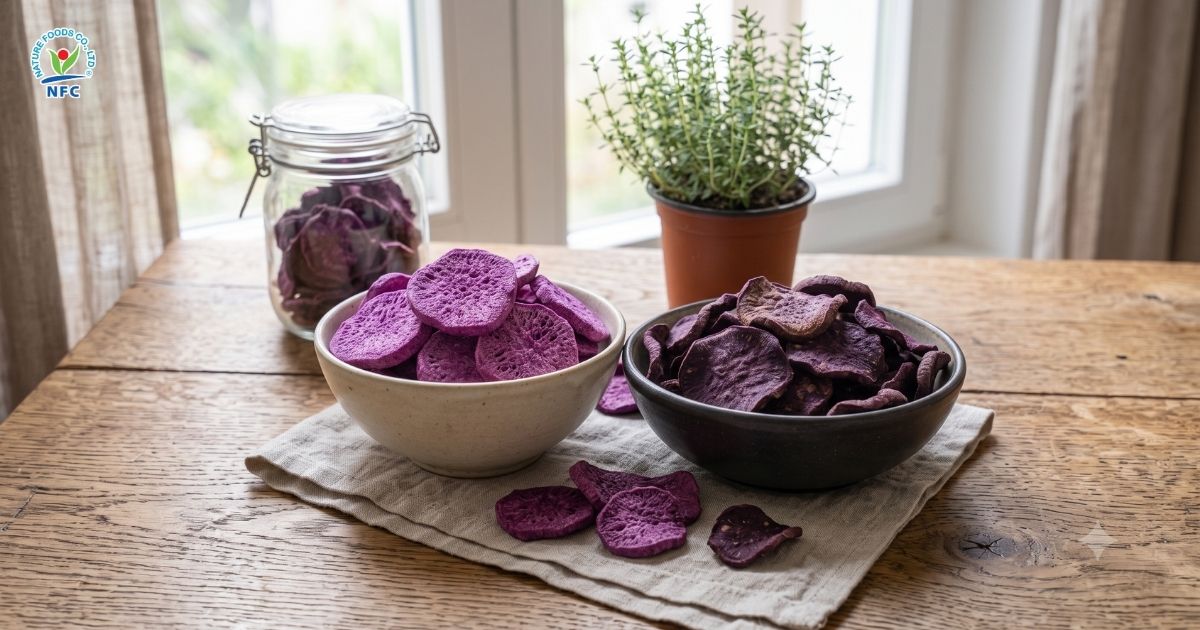
Hot-Air Dehydrated Purple Yam (Air Drying – AD)
Hot-air convective dehydration (Air Drying – AD) is an established industrial drying methodology that extracts internal liquid moisture by circulating continuous, heated positive air currents through raw material layers inside sealed drying tunnels. Under positive thermal stress (typically calibrated between 60°C and 80°C), unbound water molecules migrate from the core tissue to the outer surface of the purple yam slices and evaporate continuously into exhaust air channels until reaching target residual moisture boundaries. Thermal curves, air velocity parameters, and belt speeds are precision-controlled to regulate dehydration rates, preventing surface case-hardening while ensuring thorough core moisture removal.
Advantages of Hot-Air Dehydrated Purple Yam:
- Optimized Equipment Expenditure (CapEx & OpEx): Hardware machinery capital expenditure and daily utility electrical consumption remain substantially lower compared to advanced vacuum sublimation equipment, minimizing initial facility investment barriers.
- High Industrial Scalability for Mass Orders: Well-suited for high-volume commercial contracts demanding massive raw material throughput where unit input Cost of Goods Sold (COGS) containment is the primary economic metric.
- Flexible Moisture Parameter Control: Residual moisture levels can be precision-calibrated between 5% and 8% based on specific downstream manufacturing needs, such as industrial grinding or seasonings blending.
- Condensed Processing Lead Runtimes: High-velocity hot-air recirculation achieves steady drying throughput, enhancing factory floor operational efficiency and line turnaround times.
- Versatile Particle Formatting: Readily adaptable across multiple mechanical cutting geometries, including uniform slices, diced cubes, shreds, or coarse granules for industrial powder milling.
Disadvantages of Hot-Air Dehydrated Purple Yam:
- Thermal Nutrient Degradation: Prolonged exposure to positive heat degrades heat-sensitive vitamins (such as Vitamin C and B-complex) and partially breaks down natural bioactive compounds.
- Pigment Discoloration & Browning: The native deep purple Anthocyanin pigmentation is vulnerable to heat-induced oxidation and mild Maillard browning, causing finished dried slices to exhibit darker or duller visual tones.
- Cellular Tissue Contraction & Case Hardening: As liquid water evaporates, capillary forces pull cell walls inward, inducing severe volumetric shrinkage and yielding a denser, harder, or tougher mechanical texture.
- Altered Natural Flavor Profile: Uncontrolled thermal cycles can induce starch gelatinization and sugar caramelization, subtly altering the fresh, earthy, nutty flavor profile of raw purple yam.
Vacuum Freeze-Dried Purple Yam (Freeze Drying – FD)
Vacuum freeze drying (Freeze Drying – FD) is an advanced dehydration technology operating on direct ice-to-vapor phase-change physics (sublimation). Raw purple yam pieces undergo rapid cryogenic flash freezing at sub-zero temperatures ranging from -30°C to -50°C, locking intracellular water into microscopic ice crystals. The frozen material is then transferred into an hermetically sealed vacuum drying chamber where atmospheric pressure drops below 611 Pa (< 1 mbar). Under deep negative pressure, ice crystals sublimate directly into gaseous water vapor without passing through a liquid water phase. Bypassing liquid state transitions and insulating the material from high heat protects the natural biological cell matrix from structural damage.
Advantages of Freeze-Dried Purple Yam:
- Superior Anthocyanin Pigment Preservation: Insulated from thermal oxidation, freeze drying retains up to 95% of native purple Anthocyanin pigments, delivering vibrant visual appeal without artificial dyes.
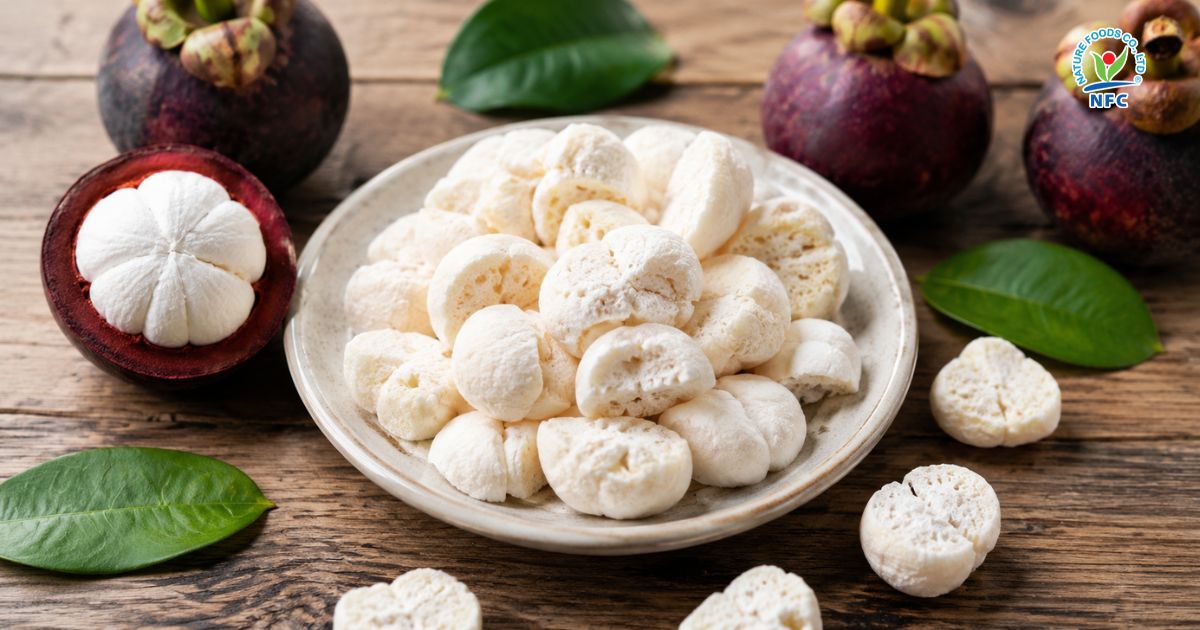
- Preserving 3D Cellular Matrix & Zero Shrinkage: Sublimating solid ice crystals leaves an open honeycomb microstructure, preserving the exact 3D volume, sharp cut edges, and dimensional shape of raw purple yam pieces.
- Maximum Bioactive & Vitamin Retention: Sub-zero vacuum processing safeguards heat-sensitive micro-nutrients, plant proteins, and dietary fibers from thermal breakdown.
- Ultra-Rapid Rehydration Kinetics: The open micro-porous matrix acts as a biological sponge, absorbing hot liquids instantly (within 1 to 2 minutes) to restore a velvety, smooth, freshly cooked texture.
- Ultra-Low Water Activity ($a_w < 0.3$): Residual moisture drops below 3%, creating an absolute microbial inhibition zone that extends room-temperature shelf life to 18–24 months without chemical preservatives.
- Pristine Clean Label Alignment: Enables brand owners to formulate 100% natural, additive-free premium products, infant weaning foods, and functional nutrition offerings.
Disadvantages of Freeze-Dried Purple Yam:
- Higher Machinery Capital Investment (CapEx): Industrial vacuum sublimation chambers and cryogenic blast freezing infrastructure require significant initial capital layouts.
- Extended Processing Cycle Runtimes: Running primary sublimation and secondary desorption phases under deep vacuums demands multi-hour factory floor cycles, increasing processing time per lot.
- Higher Unit Input COGS: Higher unit production costs position freeze-dried purple yam primarily within premium, quality-focused retail tiers rather than value-focused mass markets.
Strategic Guidance: Choosing Between Freeze-Dried and Air-Dried Purple Yam
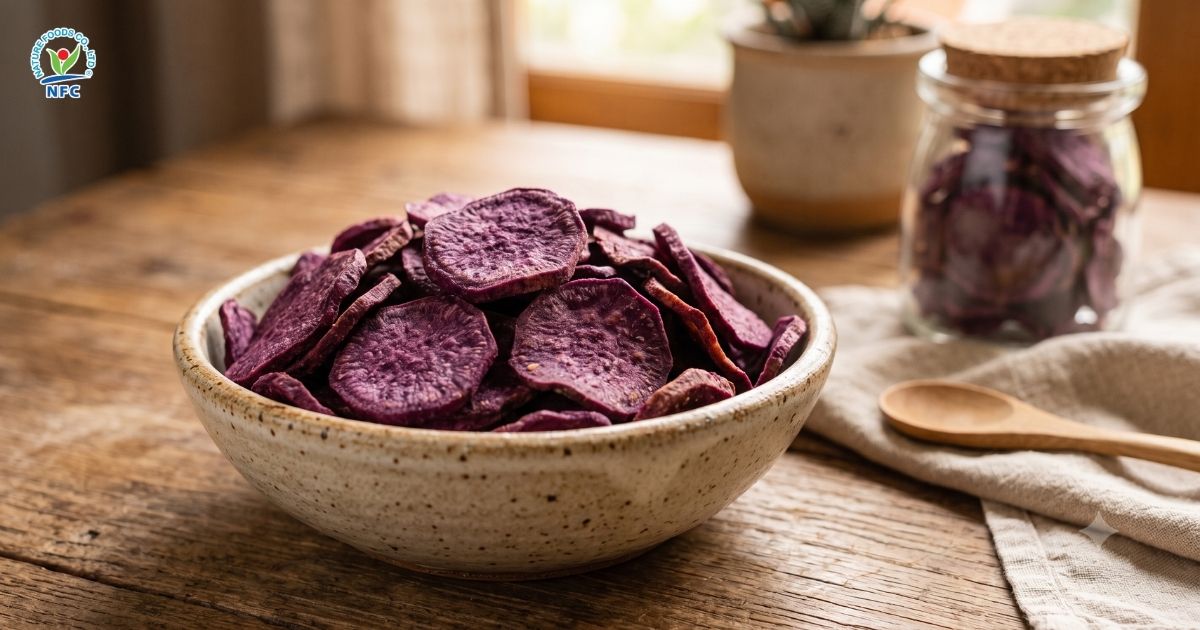
Each dehydration methodology delivers specific technical advantages aligned with distinct commercial product goals. Procurement managers, R&D directors, and brand owners should evaluate selection criteria based on target sensory metrics, consumer demographics, and unit manufacturing cost (COGS) models.
If your product roadmap targets premium retail tiers demanding pristine natural purple coloration, high nutrient retention, authentic nutty flavor, and instant liquid rehydration, vacuum freeze-dried purple yam is the superior choice. Its open porous microstructure prevents case-hardening, delivering a delicate, melt-in-the-mouth crispness as a snack, or instant solubility when milled into fine powder for beverages and baby weaning foods.
Conversely, if the primary strategic objective is unit input cost optimization for mass-market food items—such as seasoning packets in value instant noodles, industrial bakery fillings, or high-volume instant porridges—hot-air dehydrated purple yam (AD) provides a highly cost-effective, shelf-stable raw material solution with robust supply availability.
At Nature Foods, commercial clients benefit from both Air Drying (AD) and Freeze Drying (FD) industrial processing lines. Our specialized technical advisory team evaluates raw purple yam viscosity parameters, target moisture limits, and downstream application requirements to recommend the optimal processing setup—balancing sensory quality, production efficiency, and commercial profitability.
Key Evaluation Criteria for Selecting a Purple Yam Contract Manufacturer
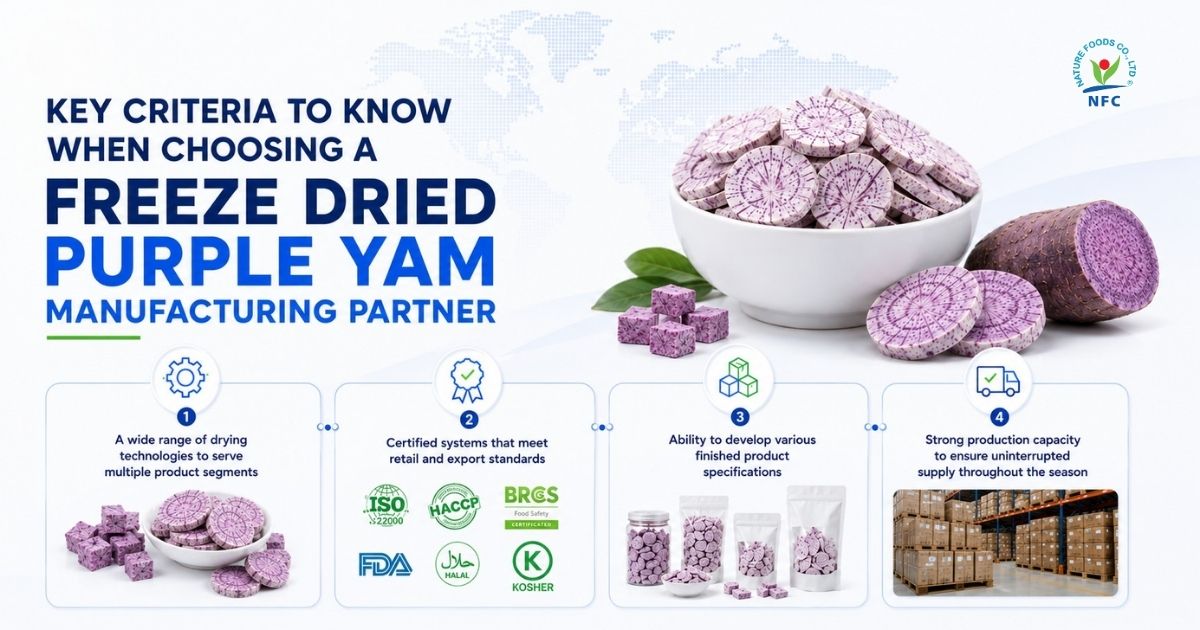
1. Multi-Technology Infrastructure for Multi-Tier Product Positioning
Different food processing sectors enforce distinct technical and cost parameters. While mass-market convenience lines prioritize low unit COGS, premium wellness offerings demand vibrant natural purple color retention, porous texturing, and rapid rehydration. Partnering with a contract manufacturer operating both Air Drying (AD) and Vacuum Freeze Drying (FD) lines allows brand owners to switch technology setups seamlessly based on market requirements. Nature Foods operates synchronized industrial AD and FD plants, servicing value-focused and high-end global food clients.
2. Verified Global Quality Accreditations for Retail and Export Clearance
As a starch-dense root vegetable containing natural mucilage, processed purple yam is vulnerable to ambient moisture absorption and microbial contamination if processing cleanrooms and packaging barrier controls are unmanaged. Partnering with a contract manufacturer maintaining audited global food safety certifications insulates brand owners from regulatory risks, product recalls, or shipment rejections.
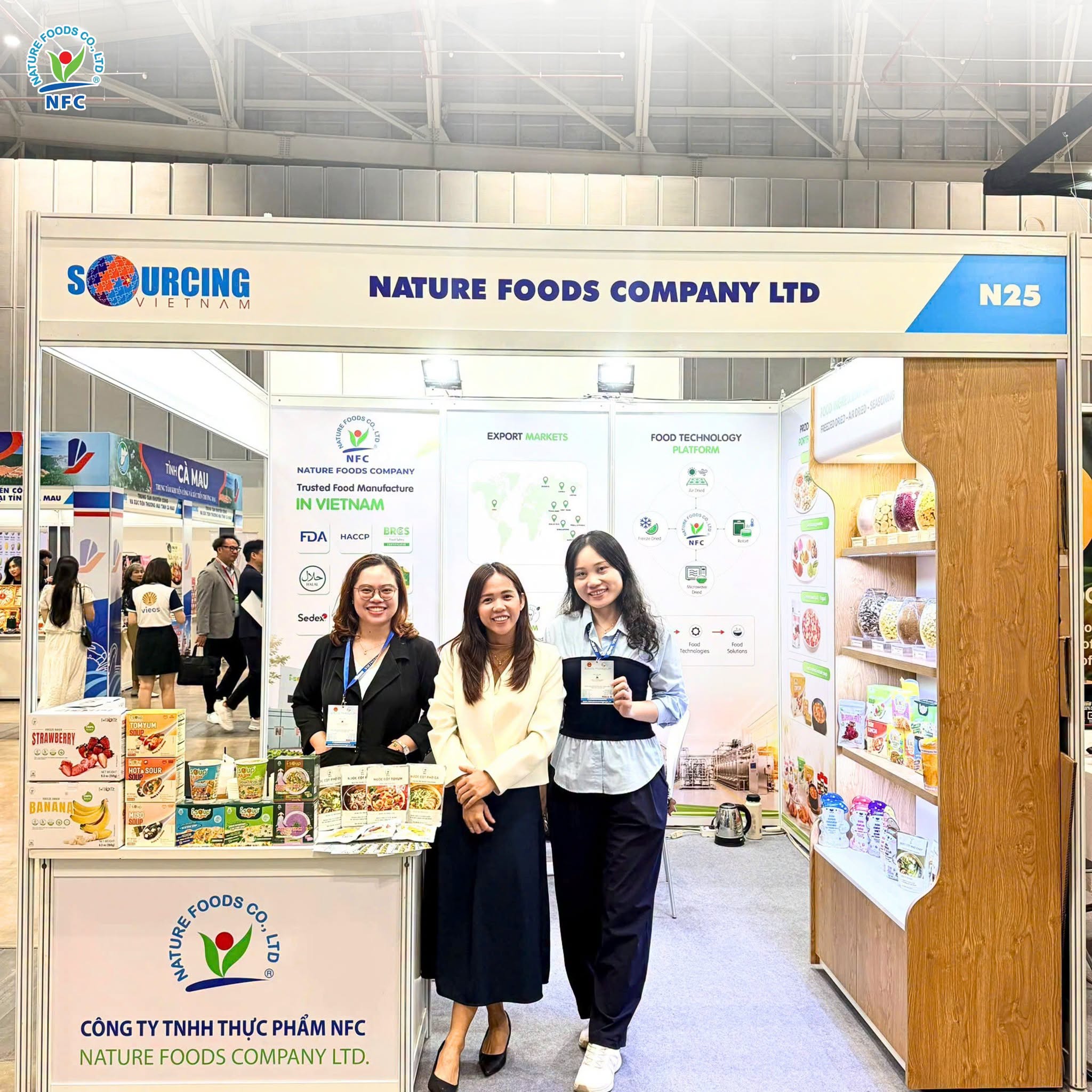
To guarantee uncompromised batch quality, Nature Foods’ processing complexes operate under strictly audited international management standards: BRCGS (Global Standard for Food Safety), ISO 22000, HACCP, HALAL, FDA (US Customs Clearance), GLOBALG.A.P., and SEDEX – SMETA—supplying the compliance passport required to clear customs filters across North America, Europe, Japan, and South Korea.
3. Turnkey Sizing, Particle Formatting & Mucilage Handling Capabilities
Downstream food manufacturing applications demand precise raw material particle specifications—spanning uniform slices, diced cubes, structured blocks, or fine-milled powders. Furthermore, raw purple yam contains high natural mucilage (viscous glycoprotein) that requires specialized pre-treatment blanching to prevent sticky clumping or thermal discoloration during drying.
Holding multi-decade tenure in B2B contract processing, Nature Foods has perfected raw purple yam pre-treatment, controlling mucilage viscosity while supporting clients across custom particle cutting, fine powder milling (target mesh fineness), lab sample prototyping, and full-scale commercial manufacturing.
4. Industrial Processing Capacity to Prevent Seasonal Supply Chain Disruptions
Raw fresh purple yam suffers from crop harvest seasonality and perishable storage limits. An ideal B2B contract manufacturer must demonstrate verified plant scale to absorb high-volume orders without supply chain bottlenecks during peak retail seasons.
As a leading B2B food dehydration enterprise in Vietnam managing over 300 SKUs and an annual factory output capacity exceeding 3,000 tons of finished products, Nature Foods effortlessly fulfills mid-scale orders and multi-ton industrial contracts for major domestic and international brands.
Conclusion
Transitioning from raw fresh purple yam to industrial processed purple yam represents far more than an extended shelf-life solution—it operates as a strategic initiative to optimize logistics overheads, eliminate raw crop waste liabilities, and capture growing Clean Label consumer demand with natural Anthocyanin purple pigmentation. Selecting the appropriate dehydration technology—whether optimizing unit input COGS via Air Drying (AD) or elevating premium brand lines through Vacuum Freeze Drying (FD)—dictates market competitiveness.
Operating as a premier B2B food dehydration contract processor in Vietnam, Nature Foods (NFC) delivers turnkey OEM/ODM/White Label solutions for global food brands:
-
Mass Industrial Plant Capacity: High-capacity facility in Nhon Trach 1 Industrial Zone (Dong Nai) yielding over 3,000 tons annually, securing uninterrupted year-round supply.
-
Tailored Technical Specifications: Custom particle formatting across slices, diced cubes (3x3mm, 5x5mm, 10x10mm), structured blocks, and pure fine powders (custom mesh size fineness).
-
Global Export Compliance Passport: Fully audited under BRCGS, ISO 22000, HACCP, FDA, HALAL, GLOBALG.A.P., and SEDEX – SMETA, clearing technical barriers into the US, EU, Japan, and South Korea.
Frequently Asked Questions Regarding Processed Purple Yam (FAQ)
1. What is the Minimum Order Quantity (MOQ) for purple yam contract processing?
To optimize factory machinery operational efficiency and deliver competitive contract pricing for our partners, Nature Foods applies flexible MOQ parameters depending on finished particle formatting (slices, diced cubes, fine powder) and dehydration technology (AD or FD).
For standard catalog specifications, MOQ typically starts from 10–20 kg to facilitate initial R&D testing. For custom formula blending, specific powder mesh fineness, or turnkey private label OEM/ODM runs, MOQ applies from 100 kg and above. Nature Foods’ sales team consults on optimized production scales tailored to your business plan.
2. Does Nature Foods provide in-house food science R&D support and custom formula development?
3. What is the standard lead time for contract manufacturing orders?
4. Does freeze-dried purple yam powder (FD) preserve its natural purple color without darkening in storage?
5. Does freeze-dried purple yam suffer from clumping due to natural mucilage (viscosity)?
6. Which global safety accreditations does Nature Foods hold to support international exports?
7. How can commercial buyers register for R&D sample testing with Nature Foods?
Commercial buyers can request complimentary R&D sample lots via a simple 3-step workflow:
- 1. Specification Intake: Client provides technical parameters (slices, diced, powder), technology choice (AD/FD), and target application.
- 2. Sample Preparation & Dispatch: Nature Foods’ laboratory prepares test sample lots and dispatches them directly for partner sensory evaluation.
- 3. Feedback & Refinement: R&D teams fine-tune specs (moisture, mesh size, color) prior to commercial contract signing and mass production.