In the highly competitive landscape of the global food and beverage industry, fresh mulberries (Morus alba and Morus nigra) have continuously stood out as a highly sought-after functional industrial ingredient, praised for their intense, vibrant natural coloration and rich, distinctive antioxidant-heavy flavor profiles. However, executing large-scale industrial product formulation with raw fresh mulberries consistently forces corporate manufacturers, procurement departments, and product development engineers (R&D) to confront persistent operational bottlenecks, including an extremely narrow annual harvest seasonality, severe physical fragility leading to rapid skin splitting during long-haul transit, and immediate susceptibility to micro-bacterial fermentation and rot. To systematically close these supply chain gaps, stabilize production cost baselines, and guarantee an uninterrupted ingredient flow all year round, implementing advanced dehydration technology has emerged as an essential strategic initiative. Particularly, the implementation of vacuum freeze-dried mulberries (Freeze Drying – FD) alongside calibrated cool-dried mulberry configurations delivers a robust, shelf-stable raw material solution that empowers corporate food brands to optimize variable expenditures, enhance total lot uniformity, and innovate high-margin, clean-label product portfolios tailored cleanly to the rising global consumer demand for health and wellness ecosystems.
- Technical and Thermodynamic Principles of Cool-Drying Mulberry Technology
- Deep Technical Comparison: Cool-Dried vs. Vacuum Freeze-Dried Mulberries
- Critical Indicators for Selecting a Bulk Dried Mulberry Contract Manufacturing Partner
- Conclusion
- Frequently Asked Questions in Bulk Dried Mulberry Sourcing & Contract Manufacturing (FAQ)
Technical and Thermodynamic Principles of Cool-Drying Mulberry Technology
What is the Technical Mechanism Governing the Cool-Drying Process of Mulberries?
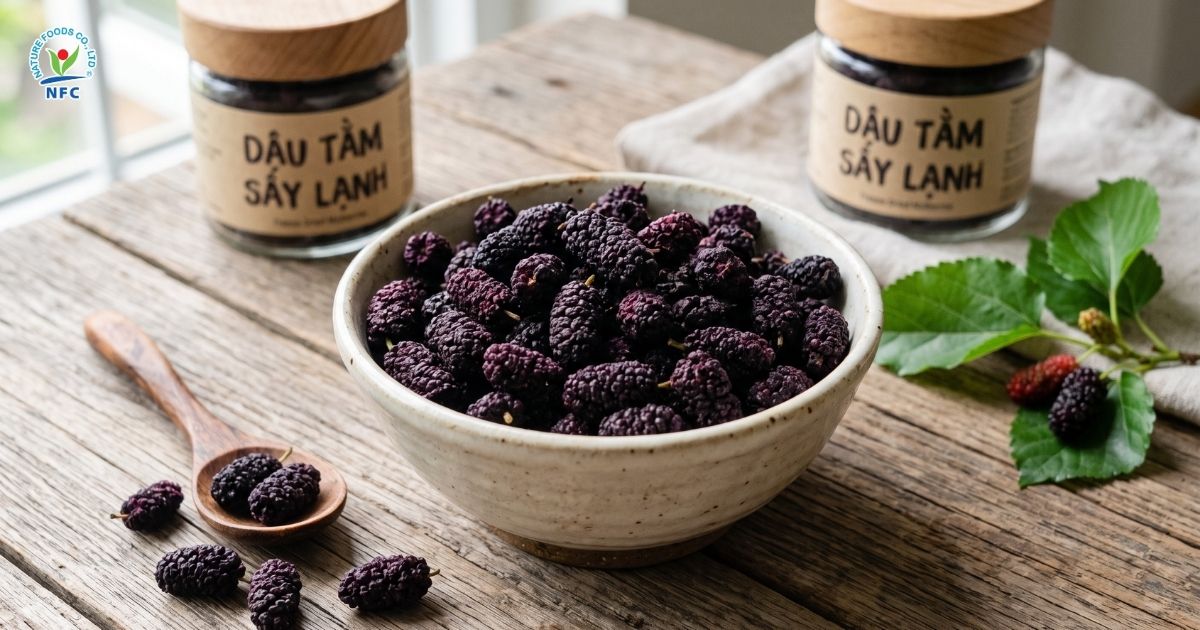
Operating on a completely separate operational architecture from conventional high-temperature hot-air convection drying (Air Drying – AD)—which forces moisture out through intense, direct thermal stress that frequently tarnish native phytochemical configurations—modern cool-drying technology (commonly classified as Heat Pump Drying) functions on sophisticated thermodynamic principles. This food engineering methodology utilizes a high-volume flow of continuously dehumidified, low-temperature air moving through a closed-loop recirculating extraction chamber, with operational temperatures strictly maintained within a gentle positive thermal range, usually calibrated below 40°C.
Throughout this specialized processing cycle, the moisture-hungry, cold, dry air is driven across the delicate surfaces of sorted mulberries, systematically extracting unbound internal moisture out of the cellular walls through a controlled vapor pressure gradient. Upon drawing out the interior moisture, the saturated humid air stream is automatically routed directly into a high-efficiency heat pump refrigeration circuit. Within this evaporator apparatus, the moisture undergoes rapid cooling to drop below its dew point, successfully condensing the extracted vapors into liquid water that is expelled cleanly from the factory floor. Concurrently, the newly stripped, bone-dry air is re-heated slightly back to its baseline operational low-temperature profile and driven back into the main dehydration tunnel to seamlessly sustain the moisture extraction loop.
By enforcing strict insulation from high-temperature spikes within the processing cells, the mulberry pulp is entirely protected from structural overheating. This technical isolation stops the early thermal crystallization and caramelization of natural fruit sugars, completely avoiding Maillard browning anomalies and preserving the sensitive native chemical assets of the fruit matrix. Crucially, this mechanism delivers unmatched protection over heat-sensitive bioactive compounds, anchoring the structural integrity of natural Anthocyanins (the vibrant purple-black antioxidant pigments) and Vitamin C concentrations that would otherwise be entirely destroyed by standard hot-air processing loops.
Core Operational and Financial Advantages of Cool-Dried Mulberries
-
Impeccable Safeguarding of Natural Coloration and Original Flavor Profiles: Because cool-drying loops are completely devoid of intense thermal shocks, the processed mulberries are cleanly protected from turning into a dull black hue or developing bitter, burnt overtones caused by sugar degradation. The finished lot retains an authentic, deep dark-purple hue and a rich, concentrated sweet-and-sour profile, presenting a highly attractive sensory profile that makes it an excellent match as an integrated inclusion inside industrial recipe formulations.
-
Highly Extended Storage Stability and Streamlined Warehousing Overhead: The intelligent moisture-desorption cycle efficiently strips out unbound water molecules, forcing the final water activity parameter ($a_w$) down into a strictly stable zone. This structural dehydration systematically dismantles the biological survival matrix required by spoilage micro-organisms, completely halting the germination of molds, yeasts, and foodborne bacteria. When handled within high-barrier aluminum foil zipper pouches or vacuum bulk liners, cool-dried mulberries achieve an extended ambient storage lifespan of up to a year, entirely freeing food brands from the massive utility and cash flow burdens of operating continuous cold chain warehousing spaces.
-
Strategic Procurement Economics and Supply Chain Margin Protection: This advanced dehydration strategy enables large F&B enterprises to permanently eliminate the supply chain vulnerabilities and pricing spikes associated with fresh berry crops. Commercial procurement offices can comfortably sign high-volume bulk-buying contracts when agricultural yields hit their seasonal peaks and cost curves are optimized. Processing these inputs into stable dry inventory allows companies to fix their baseline Cost of Goods Sold (COGS) for multi-quarter distribution cycles, protecting net operating margins from local crop inflation or seasonal scarcity disruptions.
Inherent Limitations of Cool-Drying Mulberry Applications
-
Capillary Force Tissue Collapse and Morphological Contraction: Because cool-drying technology extracts moisture from the mulberry matrix while the water remains in a liquid phase, the slow capillary fluid movement inevitably exerts high surface tension forces on the interior cellular walls. As the liquid water migrates outward, these internal forces pull the cellular layers inward, causing the structural tissue to xẹp xuống (collapse). Consequently, cool-dried mulberries suffer from noticeable morphological contraction, resulting in a shriveled, highly shrunken, and dense physical look, with a final texture that is dẻo (chewy and pliable) rather than plump or crispy.
-
Diminished Rehydration Kinetics and Sluggish Frontour SOP Performance: The severe tissue contraction and loss of open cellular walls during liquid evaporation drastically impair the material’s rehydration kinetics (rehydration profiles). When integrated into commercial tea sachets, fruit infusions, or instant beverage recipes, cool-dried mulberries demand a prolonged soaking window to absorb liquid back into their center. Furthermore, even after reaching total liquid saturation, the fruit fails to regain its native 3D plump contour, remaining wrinkled and visually compacted, which can compromise the visual aesthetics and premium presentation of artisan drinks at the storefront level.
-
Structural Threshold Boundaries within Top-Tier Premium Markets: For progressive international food brands targeting highly discerning export trading zones, upscale organic snack aisles, or elite fruit tea configurations—where corporate clients enforce zero-compromise benchmarks tracking visual elegance, zero shriveling, and an instantaneous melt-in-the-mouth crispness—standard cool-dried mulberries hit clear product positioning limitations. Fulfilling these strict high-end consumer expectations mandates the implementation of an unmatched food engineering standard: vacuum freeze-dried mulberries.
Deep Technical Comparison: Cool-Dried vs. Vacuum Freeze-Dried Mulberries
Thermodynamic and Mechanical Engineering Frameworks
Cool-dried mulberry processing relies entirely on low-temperature desiccant air loops running within positive thermal bounds to induce liquid-to-gas phase evaporation. While this effectively drives out unbound water molecules, the presence of liquid water throughout the drying cycle leaves the fruit tissue vulnerable to capillary shrinkage and mechanical tissue compression.
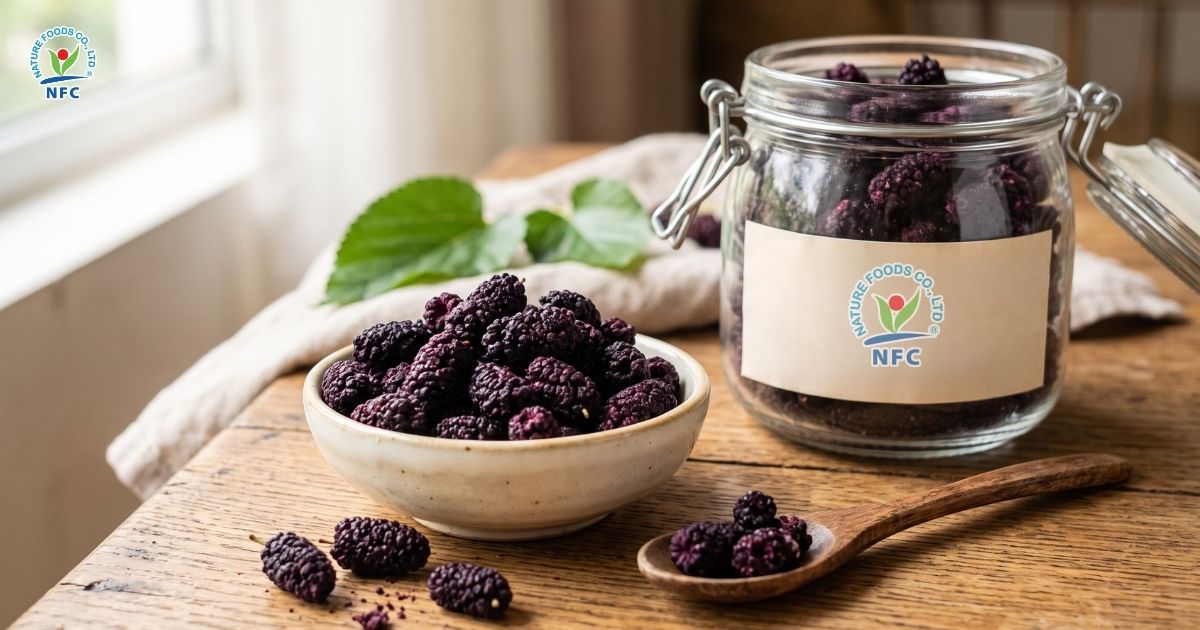
Conversely, vacuum freeze-drying technology (Freeze Drying – FD) operates on a completely separate, highly sophisticated phase-change mechanism. Freshly harvested mulberries enter industrial blast-freezing tunnels where they are subjected to sudden cryogenic sub-zero temp spikes ranging between -30°C and -50°C, instantly locking all intracellular liquid water into rigid ice crystals. The frozen berries are then moved into an hermetically sealed absolute vacuum sublimation chamber. By drawing the interior atmospheric pressure deep below the triple point of water (strictly managed under 133 Pascal), and introducing gentle, highly regulated radiant thermal energy, the integrated ice crystals bypass the liquid phase entirely, sublimating directly into gaseous vapor. This absolute circumvention of liquid water is the vital catalyst that perfectly safeguards the native 3D cellular structure of the mulberry from structural collapse or chemical alteration.
Finished Product Quality and Sensory Metrics
Cool-drying pipelines manage to deliver fair preservation of native coloration and organic sweet-and-sour flavor notes. However, because the slow moisture evacuation causes cell walls to sag and contract, the final ingredient presents a shriveled, heavily wrinkled appearance with a dense, chewy, and slightly rubbery texture that demands mechanical biting force.
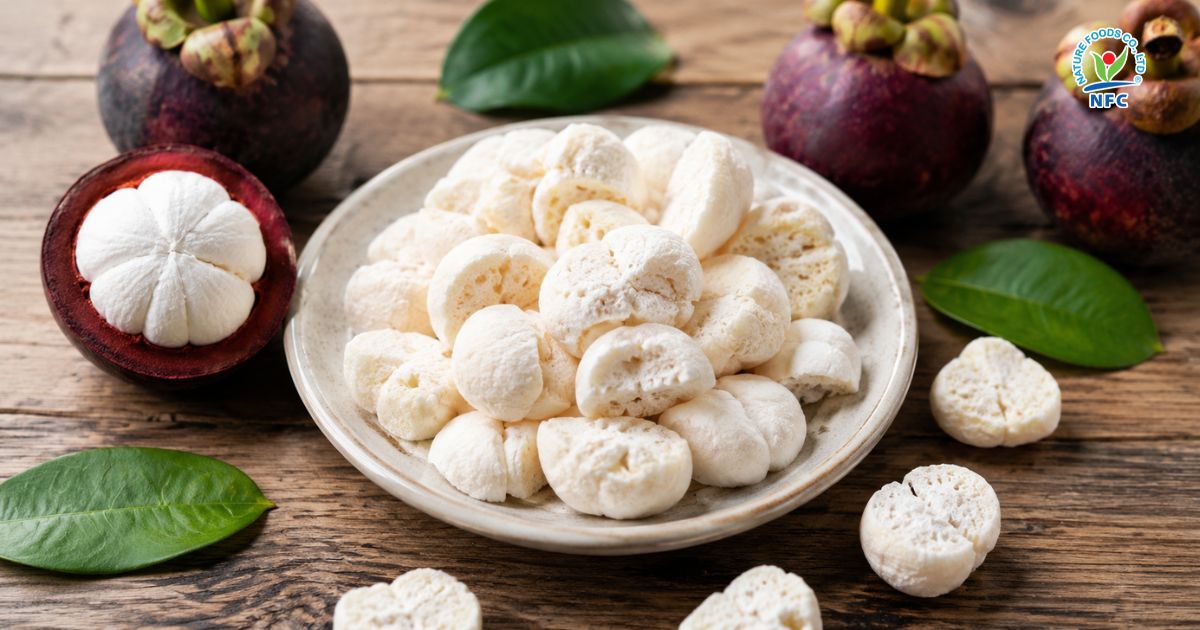
Vacuum freeze-dried mulberries stand uncompromised as the undisputed absolute gold standard for premium ingredient portfolios. Because the fruit’s structural framework is permanently locked in place during the flash-freezing phase, the final freeze-dried mulberries exhibit zero dimensional shrinkage or shape distortion. The finished berry displays an immaculate, plump 3D silhouette identical to a freshly plucked fruit, sporting a brilliant, deep indigo-purple coat. Its mechanical texture is completely transformed into an exceptionally lightweight, brittle, and porous honeycombed structure that dissolves effortlessly on the tongue, yielding an instant, concentrated burst of authentic berry flavor and safeguarding 95% to 99% of raw heat-sensitive vitamins, volatile antioxidants, and organic compounds.
Financial Projections, Production Scale, and Strategic Market Positioning
Cool-Drying Frameworks – Engineered for Large-Scale Value Optimization: Operating on a desiccant loop setup, cool drying requires moderate equipment capital expenditures (CapEx) and manageable factory power utilities. This technical cost structure positions it as an ideal operational fit for corporate brands looking to optimize production costs over massive industrial outputs, serving mass-market consumer lines, or processing bulk raw material ingredients destined for secondary industrial applications such as baked fillings, jams, fruit purees, and standard blended herbal teas.
Freeze-Drying Systems – Maximizing Commercial Valuation for Premium Categories: Due to the high-vacuum requirements and lengthy, precise multi-stage sublimation runtimes, freeze-drying lines demand higher upfront asset investment and localized energy expenditures. However, this capital footprint empowers food enterprises to command exceptional retail pricing and secure superior gross margins. The unmatched sensory metrics perfectly satisfy the unyielding standards of high-end cross-border trading regulations, premium breakfast granola lines, and elite health-and-wellness functional food formulations.
Critical Indicators for Selecting a Bulk Dried Mulberry Contract Manufacturing Partner
When navigating high-volume dried mulberry contract processing agreements, auditing a prospective contract manufacturing facility must cover far past simple baseline unit price sheet comparisons. Because the mulberry fruit contains exceptionally high levels of natural active sugars, volatile color pigments, and delicate outer skins, selecting an incompetent factory floor can immediately ruin total product lot consistency. A strategic processing ally must hold verified technical capabilities, robust floor scaling capacity, and international regulatory credentials to insulate your brand equity cleanly.
Below are the foundational evaluation benchmarks required to audit and secure an elite B2B contract processing partner:
Vast Production Footprint to Mitigate Supply Chain Bottlenecks
For expanding food brands, few situations are as damaging as executing a highly successful retail rollout only to face sudden raw material deficits or plant floor processing delays from your manufacturer. Your chosen contract processing facility must operate with an expansive industrial footprint, dồi dào (abundant) workforce limits, and redundant machinery setups to absorb massive scaling spikes comfortably—moving smoothly from initial pilot trials to continuous high-volume industrial shipping schedules without friction.
Boasting a comprehensive corporate portfolio spanning over 300 unique processed items, a centralized facility capacity clearing 3,000 tons of finished products annually, and an institutional manufacturing workforce exceeding 400 specialized floor professionals, Nature Foods (NFC) possesses the operational leverage to seamlessly execute high-volume B2B agreements. This infrastructure allows our plant to easily absorb massive volume contracts while maintaining the adaptive agility to adjust packaging layouts according to your individual corporate scaling phases.
Technology Diversity Calibrated to Private Recipe Formulations
In modern industrial food production, no single processing methodology can satisfy all product strategies or market demographics. A highly capable manufacturing partner must house a synchronized matrix of processing equipment, empowering brand managers to choose the exact technical mechanism that matches target quality targets, cellular structural profiles, and private cost configurations. Having access to specialized engineering guidance right from the initial prototyping phase is a vital asset to maximize production yields and compress development costs.
Nature Foods operates sophisticated, multi-tiered dehydration facilities, anchoring capabilities on advanced vacuum freeze-drying equipment (Freeze Drying – FD) built to satisfy elite premium sensory requirements. This technological diversity enables our engineering teams to supply authoritative, unbiased advice—assisting your R&D divisions in selecting the precise technical framework that balances color retention, structural parameters, and product positioning with your targeted operational expenditures.
Global Quality Control Frameworks and Uncompromising Food Safety Accreditations
When introducing deeply processed agricultural ingredients into high-standard international trading zones, basic sensory sorting is entirely insufficient to clear customs. Progressive import markets enforce strict analytical metrics tracking micro-biological thresholds, chemical cross-contamination, and complete pesticide residue limits. Your selected contract manufacturer must run an audited quality control architecture capable of supplying watertight documentation and absolute cross-batch validation data.
Nature Foods runs all factory floor workflows under a strict grid of elite international certifications, proudly holding current registrations across BRCGS (Global Standard for Food Safety), ISO 22000, HACCP, FDA (USA Clearance), and HALAL. Backed by rigorous agricultural tracing programs conforming to GLOBALG.A.P. and comprehensive corporate social responsibility data compiled under SEDEX – SMETA, partnering with NFC provides your brand with verified regulatory passports to clear complex custom entry points across North America, Europe, and Asia with absolute peace of mind.
Turnkey OEM/ODM White Label Solutions: From Prototyping to Market Domination
Many progressive consumer food startups and established retail groups look to deploy premium processed berry lines but prefer to avoid the immense capital layout and operational liability of building a private physical plant. This makes full-service OEM/ODM or White Label contract frameworks an invaluable strategic asset. An elite partner must provide complete, turnkey support—stepping beside your team through raw input selection, custom milling, recipe stabilization, test-batching, and legal labeling documentation.
Different commercial distribution tracks enforce unique rules tracking bulk sizing layouts, barrier pouch materials, and private packaging layouts. Partnering with an institutional contract manufacturer like Nature Foods—who possesses deep, multi-decade experience supplying dominant global supermarkets and multinational food conglomerates—systematically de-risks your product rollout, accelerates overall time-to-market, and frees your executive teams to focus entirely on macro brand expansion.
Conclusion
In summary, the permanent selection of an agricultural dehydration technology depends entirely on your brand’s overarching market positioning strategy, targeted cost configurations, and targeted consumer demographics. While cool-dried mulberries act as a highly efficient, economically optimized ingredient choice built to support high-volume mass-market retail lines and value-focused product formulas, vacuum freeze-dried mulberries (Freeze Drying) stand uncompromised as the ultimate strategic lever to maximize finished product value. Boasting an unrivaled capability to preserve the plump 3D fruit contour, brilliant natural color saturation, ultra-rapid rehydration profiles, and the complete phytochemical and antioxidant asset index native to raw orchards, freeze-dried mulberries deliver the undisputed gold standard required to win affluent health-conscious consumers and clear rigid global export codes smoothly.
To transform this premium processed ingredient concept into a highly scalable commercial reality without absorbing heavy capital liabilities, expensive equipment procurement risks, or seasonal sourcing deficits, joining forces with an accredited B2B contract manufacturing leader like Nature Foods (NFC) is a critical strategic milestone. Combining immense industrial facility scaling limits, comprehensive turnkey OEM/ODM/White Label processing frameworks, and an unyielding foundation of world-class food safety accreditations (BRCGS, ISO 22000, HACCP, FDA, HALAL, SEDEX-SMETA), Nature Foods proudly operates as your premier launchpad—empowering your brand to master advanced freeze-drying technology and confidently assert market dominance across the global F&B arena.
Frequently Asked Questions in Bulk Dried Mulberry Sourcing & Contract Manufacturing (FAQ)
1. Should our enterprise select cool-dried or freeze-dried mulberry ingredients for our product line formulation?
The optimal operational selection relies entirely on your targeted retail demographic positioning, specific recipe application, and your product’s target Cost of Goods Sold (COGS). If you are looking to secure high-performance, value-optimized raw materials to incorporate into industrial baking mixtures, wholesale berry jams, mass-distributed snack mix bags, or standard blended loose-leaf teas, cool-dried mulberries offer an excellent, highly balanced financial solution.
However, if your corporate roadmap seeks to position SKUs within premium retail spaces, upscale health hampers, luxury detox fruit tea blends, or strict cross-border export channels, freeze-dried mulberries (Freeze Drying) operate as an absolute mandatory requirement. This advanced technology allows the fruit to lock in its natural 3D plump contour, vivid original color profiles, a delicate crispy mouthfeel, and near-absolute nutritional assets—sensory and structural milestones that cool-drying methods are completely unable to deliver.
2. Does Nature Foods accept large-scale, custom contract manufacturing orders for freeze-dried mulberries according to private corporate specifications?
Yes, absolutely. Nature Foods (NFC) operates as a leading institutional provider of turnkey B2B food processing solutions, managing full-scale OEM/ODM and White Label contract agreements. For mulberry raw inputs, our facility floors focus heavily on implementing state-of-the-art vacuum freeze-drying loops engineered to Japanese industrial standards, outputting premium finished lots with the highest possible commercial valuation.
Leveraging our mass factory footprint located within Nhon Trach Industrial Complex, an annual capacity clearing 3,000 tons of dry inventory, and an elite in-house R&D engineering division, Nature Foods confidently absorbs high-volume bulk contracts. We tightly guarantee impeccable batch-to-batch uniformity, strict microbiological compliance, and absolute protection of your proprietary R&D formulas and confidential corporate recipes.
3. What makes the rehydration kinetics and storefront application of freeze-dried mulberries superior to cool-dried lots?
Because freeze-drying technology drives moisture out via ice crystal sublimation within a high-vacuum chamber, the final material completely avoids fluid capillary force collapse. This leaves the final freeze-dried mulberry with an open, honeycombed cellular structural profile that functions identically to an adaptive biological sponge. This physical trait unlocks exceptional rehydration kinetics; upon contact with liquid, the dry berry absorbs moisture near-instantly, returning seamlessly to a plump, fresh-like, and juicy state. This makes it a perfect fit for premium iced teas, lifestyle yogurt toppings, or gourmet granola blends.
Conversely, because cool-drying loops slowly evacuate moisture while in a liquid phase, the interior cells suffer from severe capillary compression and permanent tissue flattening. The resulting cool-dried berry carries a dense, chewy, and rubbery texture that exhibits very poor rehydration curves, requiring lengthy soaking times and remaining wrinkled and aesthetically compacted even after total saturation.
4. What is the Minimum Order Quantity (MOQ) tracking dried mulberry contract processing at Nature Foods?
Master MOQ thresholds at Nature Foods are agilely adjusted based explicitly on your target technology channel (Hot Air AD, cool drying, or premium Freeze Drying FD), your desired product cut dimensions, and your targeted container configurations (whether purchasing bulk raw materials inside thick cardboard boxes with food-grade liners or finalized consumer pouches sealed under high-barrier aluminum zip layers).
Beside providing adaptive MOQ policies designed to optimize your working capital allocation, Nature Foods delivers full, end-to-end institutional support. Our corporate divisions actively guide your team through pilot test-batching (R&D), analytical laboratory validation, product registration dossiers, and securing specialized international customs certificates (FDA, BRCGS, ISO 22000, HALAL, etc.), ensuring your finished goods smoothly clear regulatory custom hurdles or confidently land premium shelf positions inside top-tier global supermarket chains.