Cordyceps mushroom stands as one of the highest-value functional raw materials in the nutraceutical and dietary supplement industries. For commercial enterprises, the selection of processing technology directly dictates the final mechanical shape, color saturation, and bioactive compound retention rate of the finished product. Let Nature Foods put processing methods onto the economic scale to help your organization make the right investment decision!
- Dried Cordyceps Mushroom: From Perishable Vulnerability to Long-Term Stability
- Dehydration Methodologies for Manufacturing Dried Cordyceps Mushroom
- Freeze-Dried vs. Conventionally Dried Cordyceps: Which Should Enterprises Choose?
- Key Criteria for Selecting a Custom Dried Cordyceps Contract Manufacturer
- Conclusion
- Frequently Asked Questions (FAQ)
Dried Cordyceps Mushroom: From Perishable Vulnerability to Long-Term Stability
Cordyceps mushroom represents a high-value medicinal and functional food ingredient with exceptional commercial valuation. It is widely formulated into premium herbal tea infusions, ready-to-drink luxury bird’s nest jars, functional nutraceutical supplements, and high-end corporate gift hampers.
However, utilizing raw fresh mushrooms poses complex operational challenges for procurement directors and R&D managers:
-
Excessive Free Water Content: Fresh mushrooms carry an internal water mass ranging from 85% to 90%.
-
Extremely Narrow Shelf Life: Without uninterrupted cold chain logistics, the produce suffers rapid mold decay, color browning, and total enzymatic degradation in just 3 to 5 days.
-
Logistics Liabilities: Expensive refrigerated freight bills and high supply chain risks during long-distance distribution or cross-border export routines.
Transitioning toward dried Cordyceps mushroom brings residual moisture down into safe parameters (below 10%), completely isolating spoilage micro-organisms and extending room-temperature shelf life to 12 to 24 months under ambient warehousing.
Dehydration Methodologies for Manufacturing Dried Cordyceps Mushroom
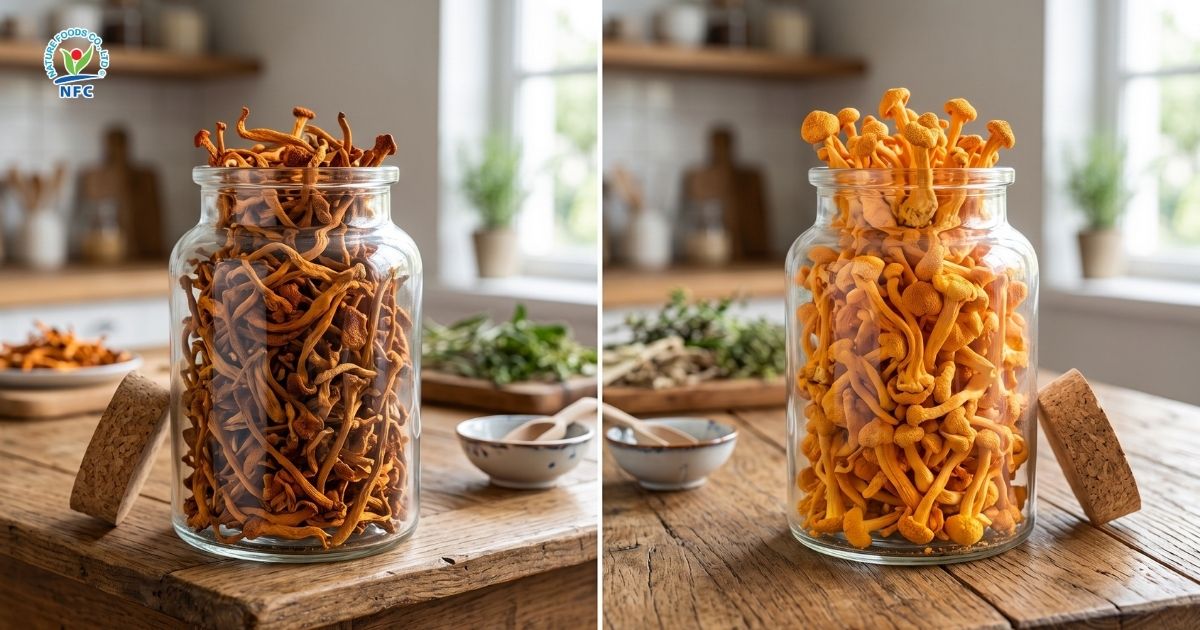
To assist enterprises in selecting the optimal technology aligned with target market positioning and budget allocations, below is a detailed technical comparison matrix:
| Evaluation Metric | Freeze Drying (FD) | Cool Drying (Heat Pump – HPD) | Hot-Air Convection Drying (AD) |
| Physical Mechanism |
Direct ice-to-vapor sublimation in absolute vacuum |
Dehumidified low-temperature air condensation |
Convection moisture evaporation via hot air currents |
| Thermal Range | Deep sub-zero (-30°C to -50°C) |
Low positive (35°C to 50°C) |
High positive (> 60°C) |
| Residual Moisture |
Ultra-low (1% – 3%) |
Low (5% – 10%) |
Moderate (10% – 14%) |
| Bioactive Retention |
Preserves 95% – 98% Cordycepin & Adenosine |
Good (70% – 80%) |
Heavy loss due to heat degradation |
| Morphology & Texture |
Pristine 3D shape, zero shrinkage, porous & crispy |
Slightly shriveled, pliable/chewy |
Severe contraction, brittle, dark browning |
| Rehydration Speed |
Ultra-rapid (30 – 60 seconds) |
Sluggish, requires long soaking |
Very poor, remains tough & fibrous |
| Market Segment |
High-End Premium, Cross-border Export, R&D |
Mid-tier, Mass Retail |
Budget tier, basic raw material |
Freeze Drying Technology (FD)
Operating Mechanism: Fresh fruiting bodies are rapidly flash-frozen at deep sub-zero temperatures (-30°C to -40°C). Moisture is subsequently extracted via direct vacuum sublimation from solid ice crystals into gaseous vapor.
Characteristics: Flawlessly retains original morphology and vivid golden-orange coloration (preventing structural shriveling or breakage). Crucially, this cold vacuum process safeguards heat-vulnerable active compounds, including Cordycepin and Adenosine.
Cool Drying Technology (Heat Pump – HPD)
Operating Mechanism: Deploys dehumidified, circulating cool air at low temperatures to continuously draw moisture out of the fungal tissue.
Characteristics: Maintains fair color integrity; however, the mushroom strands show slight physical shrinkage and a chewier texture compared to freeze drying. Heat-sensitive bioactives are preserved at a moderate baseline.
Hot-Air Convection Drying (Air Drying – AD)
Operating Mechanism: Uses direct hot air currents (typically exceeding 60°C) to force rapid thermal evaporation.
Finished Product Profile: Mushroom strands shrink significantly, turn brittle, and darken to a dull brown hue due to sugar caramelization. High heat heavily degrades active vitamins and medicinal compounds.
Freeze-Dried vs. Conventionally Dried Cordyceps: Which Should Enterprises Choose?
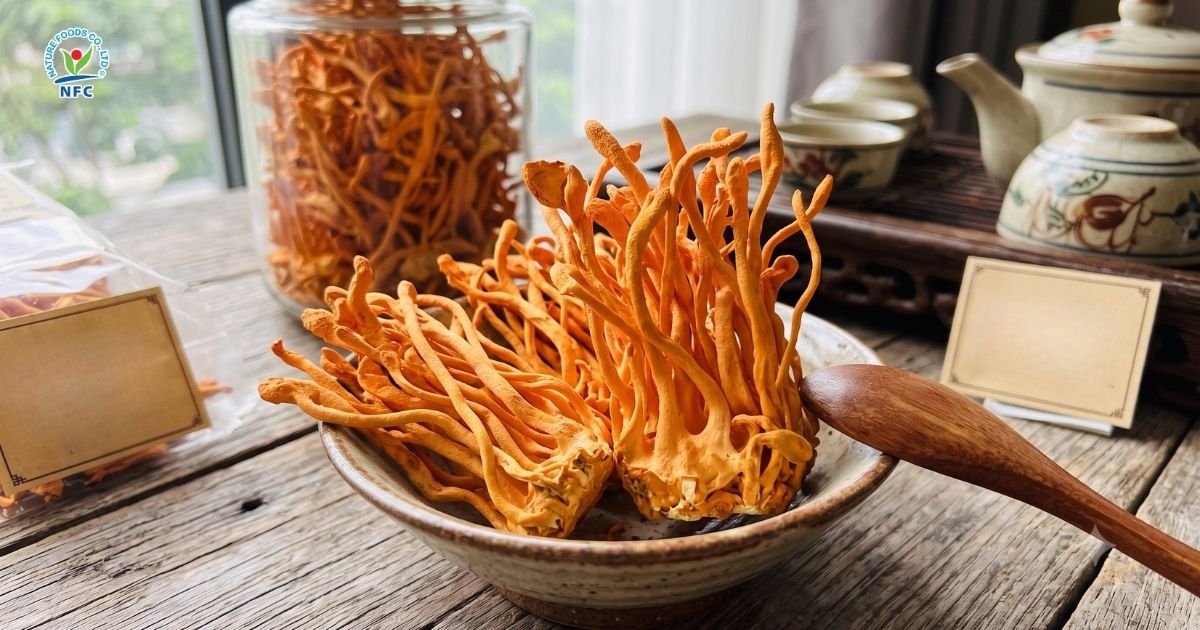
While both approaches resolve shelf-life extension, their impact on sensory quality, bioactive retention, and final manufacturing cost exhibits clear commercial division.
Vacuum Freeze Drying (FD) currently stands as the gold standard for processing Cordyceps mushroom due to its specialized dehydration mechanism, delivering key commercial moats:
Maximum Retention of Heat-Sensitive Bioactive Compounds:
Vital medicinal compounds and native vitamins degrade rapidly under high temperatures. Sub-zero vacuum freeze drying preserves up to 98% of original bioactive values.
Preserving Full 3D Contour without Shriveling or Distortion:
Unlike heat or cool drying that cause cellular collapse, freeze drying sublimates moisture directly from ice crystals. Consequently, the original strand dimensions and volume are preserved intact.
Porous Microstructure Driving Instantaneous Rehydration:
Freeze-dried Cordyceps strands are ultra-lightweight and highly porous. When brewed into teas or bird’s nest bowls, the tissue draws liquid instantly, returning to a plump, tender state and releasing active nutrients far faster than alternative dried formats.
Commercial B2B Applications:
- Whole-strand premium inclusions for luxury bird’s nest jars, high-end gift sets, and loose-leaf herbal teas requiring flawless visual presentation.
- High-purity raw material for milling into ultra-fine powders feeding functional capsule, tablet, and effervescent sachet lines.
- Cut-size inclusions for healthy tea sachets, liquid dietary supplements, and botanical extracts.
Key Criteria for Selecting a Custom Dried Cordyceps Contract Manufacturer
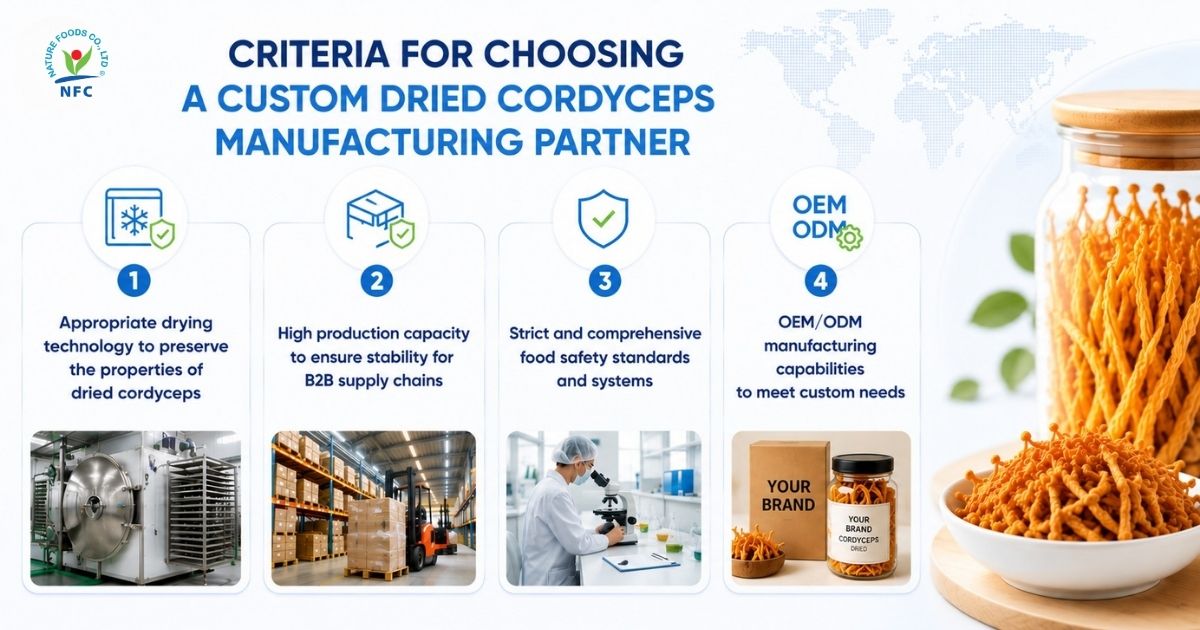
Dehydration Technology Matched to Product Specifications
Cordyceps fruiting bodies are delicate, carry high water content, and pack heat-sensitive bioactives. Enterprises should prioritize manufacturing partners equipped with versatile dehydration setups to select the optimal processing path.
Housing synchronized vacuum freeze drying (FD) and air drying (AD) systems, Nature Foods supports custom Cordyceps processing tailored to target sensory metrics, application requirements, and market tiers.
High-Volume Industrial Capacity for B2B Supply Chain Security
Supply chain bottlenecks and lot-to-lot inconsistencies introduce severe operational risks for consumer food brands. An ideal contract processor must demonstrate verified capacity, smoothly transitioning from pilot trials to full-scale automated mass production.
Operating a centralized modern facility in Nhon Trach 1 Industrial Zone (Dong Nai) with an annual capacity exceeding 3,000 tons of finished products across 300+ SKUs, Nature Foods ensures reliable supply continuity for corporate clients.
Rigorous International Food Safety Accreditations
Medicinal mushroom products demand strict quality control over raw input lineage, processing parameters, and finished lot purity to clear domestic distribution and international trade filters.
Nature Foods operates under world-class quality management frameworks, fully certified across BRCGS, ISO 22000, HACCP, FDA, and HALAL—guaranteeing product safety and regulatory compliance for every batch.
Flexible Turnkey OEM/ODM Contract Services
Every brand maintains distinct commercial strategies, ranging from bulk raw material procurement and private-label tea packaging to luxury glass jar gift set design.
Nature Foods delivers comprehensive OEM/ODM solutions—assisting partners through formula refinement, technology selection, custom packaging design, and complete finished product execution.
Conclusion
Transitioning from fresh produce to dried Cordyceps mushroom—particularly deploying advanced vacuum freeze drying (Freeze Drying)—represents a strategic move for F&B and nutraceutical brands to optimize operational expenditures, safeguard active medicinal value, and penetrate international export channels confidently.
Selecting the right dehydration technology and an accredited contract manufacturing partner is the key to building sustainable brand equity and commanding premium market positioning.
Partner with Nature Foods (NFC) to Elevate Your Product Portfolio
Boasting over 23 years of specialized tenure in industrial food dehydration, Nature Foods (NFC) stands as your trusted strategic B2B manufacturing partner.
-
End-to-End B2B Solutions: Complete support across OEM / ODM / White Label frameworks, from lab-scale R&D pilot runs to mass industrial manufacturing.
-
Versatile Particle Formats: Precision processing for whole premium strands, cut-size tea inclusions, or 100% pure fine-milled powders.
-
Global Compliance Passport: Fully certified facility floor operating under BRCGS, ISO 22000, HACCP, FDA, and HALAL umbrellas.
Frequently Asked Questions (FAQ)
1. What is the standard commercial shelf life of dried Cordyceps mushroom?
2. Why does freeze-dried Cordyceps retain higher bioactive levels than heat-dried alternatives?
3. Do freeze-dried Cordyceps strands suffer from shriveling, breakage, or discoloration?
4. How do the rehydration kinetics of freeze-dried Cordyceps compare to other dried formats?
5. Does Nature Foods (NFC) support custom cutting and particle sizing for B2B orders?
Yes, fully. NFC provides versatile pre-treatment and cutting options customized to B2B R&D requirements, including:
- Whole Premium Strands: Ideal for luxury bird’s nest jars, high-end tea blends, and corporate gift sets.
- Cut Slices / Inclusions: Engineered for tea sachets and gourmet instant soup mixes.
- 100% Pure Fine Powder: Ideal for functional capsules, tablets, drink mixes, or cosmetic formulations.